SPX Haul 2025: Reviews Part 5
Nine stories reviewed! Nine! *SCREEEEEEEEEAAAAMMMMMMMMMMMMS*
Back in September, I traveled down to Bethesda, Maryland and picked up a whole host of comics. Some are long, some are short. Not sure if all are good as I haven't read most of them. That's what we're here to find out. As I read through my pile, I'll be typing up reviews and sending them out. Some installments might have a few, some may have one. All depends on how much I feel I need to write and how many I've read.
In this fifth installment, I review one of the anthologies I picked up. If I realized just how much work reviewing an anthology would be, I would have saved my read of these for the end of my pile instead of randomly in the middle.
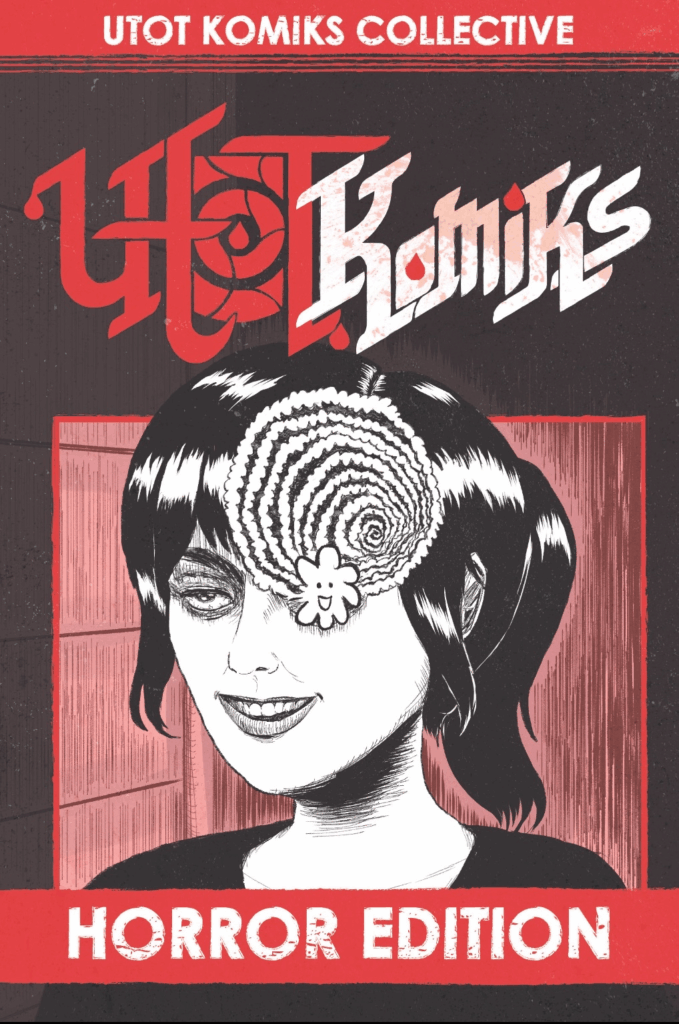
Utot Komiks: Horror Edition
One of my favorite collaborative anthologies from SPX! A rotating cast of creators, with a few anchors for every volume, tasked with creating a short comic on short notice. Doesn’t have to be good. Isn’t usually bad. It’s all about farting out those ideas and getting to work.
Me though? Turns out farting out a review is way harder. Reviewing these stories took me so long folks! At least a month of writing on and off. I love anthologies. I truly do. I have no idea how best to review them.
I knew I couldn’t write 9 full length reviews but the nature of the project meant I want to give everyone their due while still having constructive critiques. I mean, that’s always true but professionally published work with tons of editors that I have to pay $4.99 (so much!) for 22 pages gets judged with a much sharper and less forgiving eye. I can't just go "look a horse!" and be done.
Also, apologies for the DIY photos of comics page and weird cropping. Didn't think it was appropriate to have my fingers in the frame and holding open this volume to photograph one handed was a PAIN. Is there a better method? Probably.
This year’s theme (or, I guess last year’s?) was horror with a very fun homage cover of Junji Ito’s “Uzumaki.” Fear the spirals folks! They’ll get ya.
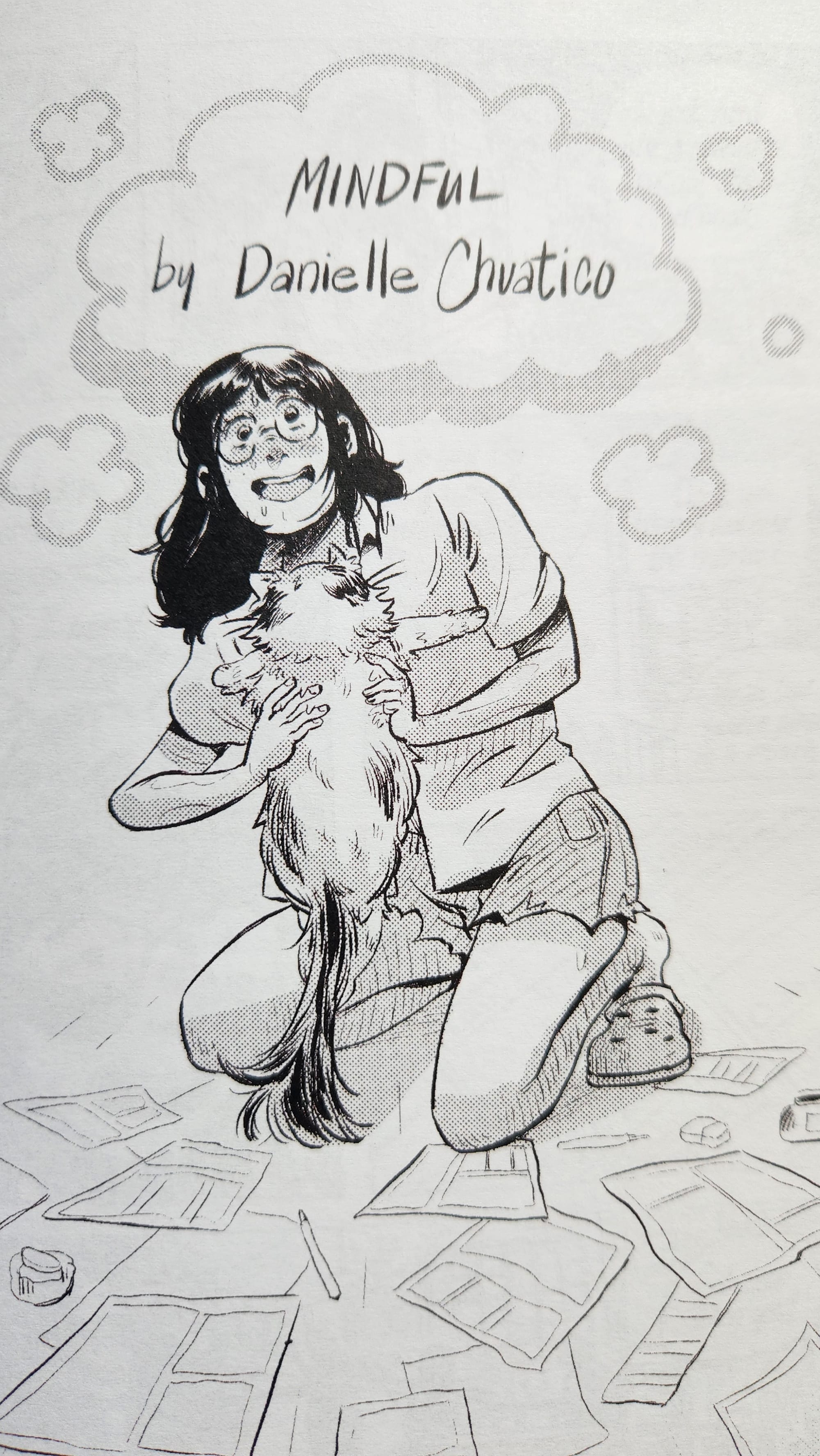
Mindful
A great story that hits way too hard for me, especially because I originally read this story in November and had to re-read the whole anthology to remember what each story was about…
As with many of these anthology titles, the central premise revolves around not being able to come up with a comic idea. Our fictionalized authorial protagonist slowly spirals out as the deadline approaches and, well, you know how these kinds of stories end. It’s predictable but well told. The art’s great: scratchy inks and a few screentones really give it that gothic feel and Dani’s figurework shows off their knowledge of how to draw hands! Those hands are so good. I’m a sucker for long fingers in comics, apparently.
I particularly like the interplay between Dani and her thought balloons. The tactile nature of the clouds drives home the tangibility of ideas and their effects on us, particularly on creative professionals. I love the various ways Dani puts the “I should be making comics” thought away - waving, crumpling into a pocket, tossing like a basketball. Not only does this work for the comedic moments, it’s integral to the climax of the piece. The metaphorical becoming literal.
Lock in or perish! The perfect EC comics version of the title.
SHEEPHEAD
I had fun with this one! Not my favorite, as it’s a very typical monster of the deep story, however it’s clean, well told, and direct. There’s very little flab in the story, starting us with all the exposition we might need, just enough characterization to get me to care about our two nameless protagonists, some good fan-service shots of the guy’s abs - mmmmm abs - and then it’s off to the races!
Joli builds the tension of what’s in the mysterious dark hole in the ocean and what might be happening to the sea urchins well and then delivers with a giant fish! HUGE! She chooses a not scary fish - the California Sheephead - as the culprit, which I appreciated. There are enough giant, sharp-toothed or tentacled sea dwellers in horror. Just make a small thing big and even the most innocuous, gap-toothed maws become terrifying.
The main flaws come down to its predictability and the cleanliness of the art style, which is a weird criticism, I know. I never really felt the oppressive darkness of the sea. The hole at the start was pitch black and foreboding. However, once in the water, there was always a lot of light. A mismatch that, in a longer story, could have worked but not in one this short. There’s also an overreliance on speed lines in the action beats, not helped by the relatively static nature of the character's faces, too.
Yet, the paneling is well constructed and the environments well observed. The economics of the story shouldn’t be dismissed, even if it didn’t fully have the intended effect. Also, that spread with the Sheephead is properly eerie. Kudos!
Fallen by the Wayside
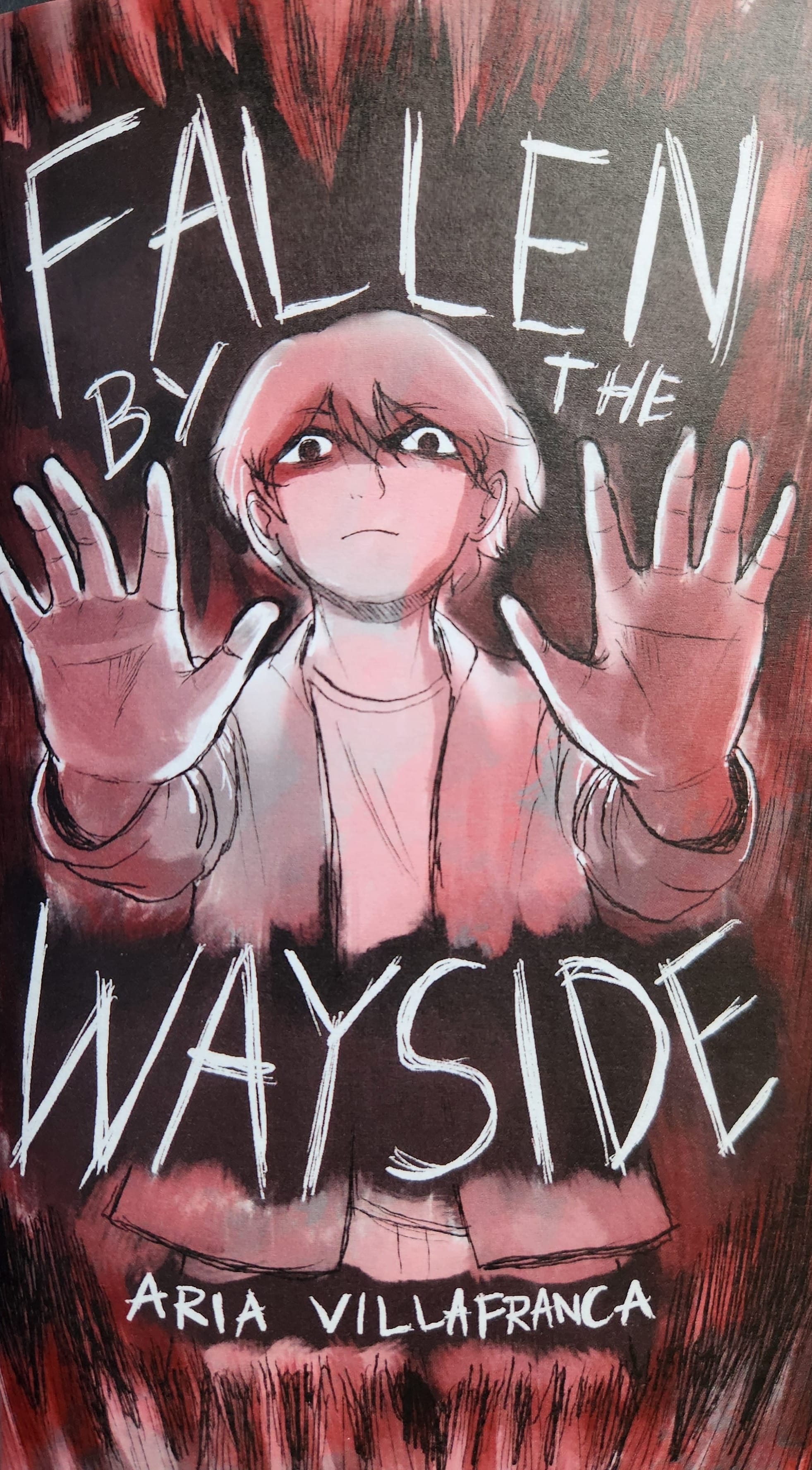
Visually, this story feels the most “drawn in four weeks.” A true representation of the exercise of making a comic under a tight deadline, warts and all. Rather than a polished piece, “Fallen” is us looking at a first draft. The storyboards and test pencils of what would be tightened up into a great little horror vignette. Dialog would be refined to smooth out some of the clunkiness.
That said, it’s still quite effective. The pacing is already here and the paneling is very clear. The story is also easy to understand, that of a bullied kid who finds a monster in the woods and figures out there’s now an easy and effective way of taking care of the bully…permanently. You get the satisfaction of revenge and there’s a good twist at the end that supports the thematic weight of “be careful playing with monsters, lest you become one too.” Villafranca deploys “bitch” well to this effect, reframing the bullied into the bully rather cleanly.
I don’t know why this did it for me more than “SHEEPHEAD.” Maybe the grotesque look of the creature in the woods? Villafranca draws a killer creature here. So many limbs! Such a gross tongue.
A Guide to People Watching
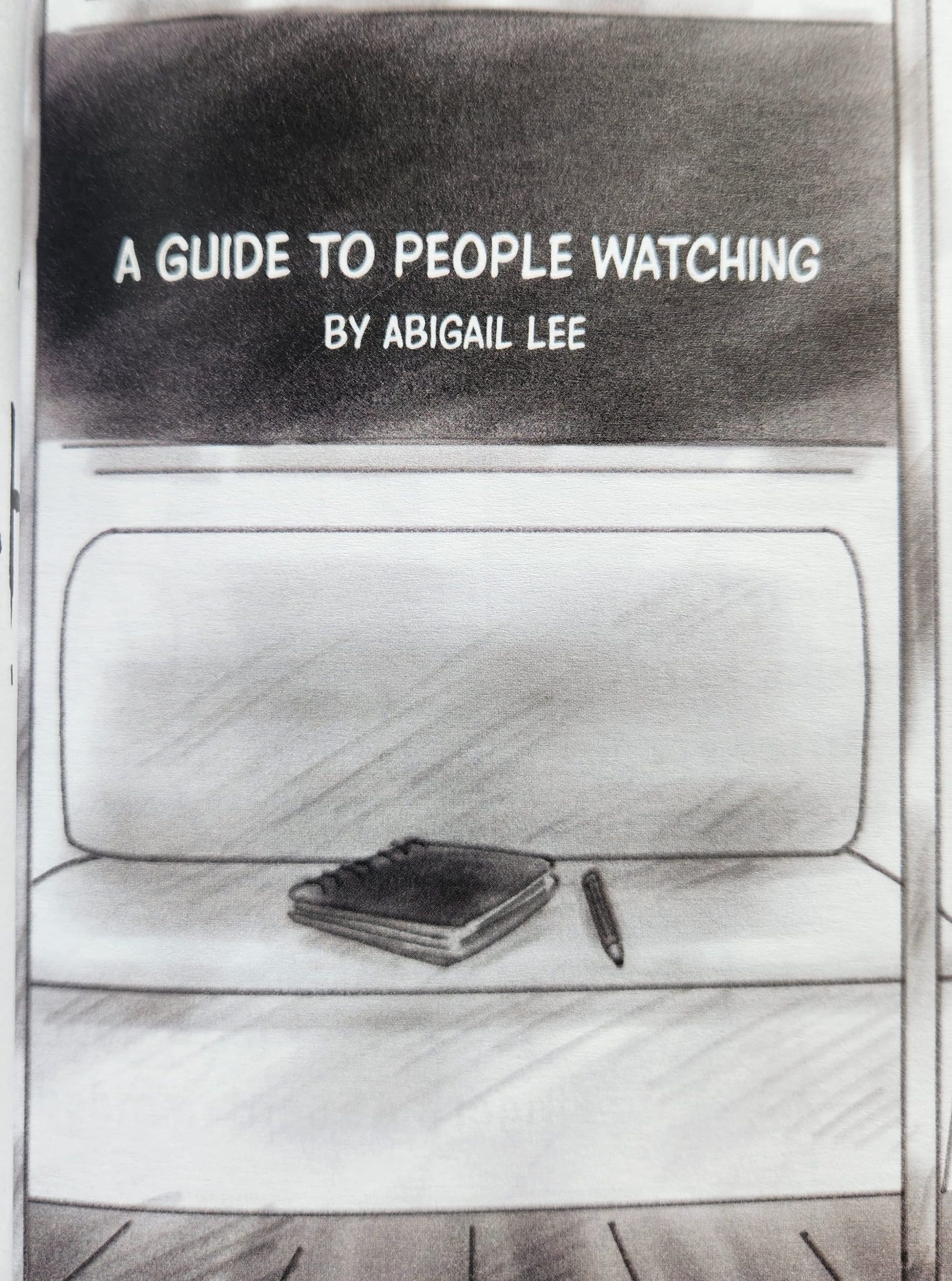
This is one of my favorites of the collection. I love how it plays with perspectives and keeps the focus tight. That we never see our nameless narrator, as if we’re viewing the world through their eyes. Hands, yes. The occasional wrist. A notepad and pencil. Nothing more.
The horror of the piece is quiet, small, only truly there when one considers the obsession present in their actions. The narrator is an observer and an absorber, paying attention to the little details but not knowing how not to overstep into some stranger’s life. It’s reminiscent of parasociality, this feeling of knowing another without actually knowing them. In this case, it’s an older form, where the imagination fills in all the gaps rather than having copious amounts of true knowledge.
What happens, then, when the observer is observed? When the lens is flipped? What do we feel? What do we do? I like how it ends on these questions and on the quiet of a full train and an abandoned notepad.
Anyway, I like how detached the narrator is, allowing the disconnect between their staccatoed observations and reality to unsettle us, like when the skater falls off their board and they are drawn sitting in a field of flowers, only for the next page to show blood pouring out of their head, cradled by a friend, as others freak out around them. Of course, all of this is seen from a distance.
The figure work is admittedly stiff. I did not even realize the skater had fallen off his board, it went flying off to the left of the page, when I first read it. He just kinda looks like he’s mid-trick; the perspective between him and the board making it difficult to parse size and position. Still, that I called this my favorite speaks to the success of the narrative and its telling.
But I Don’t Mind
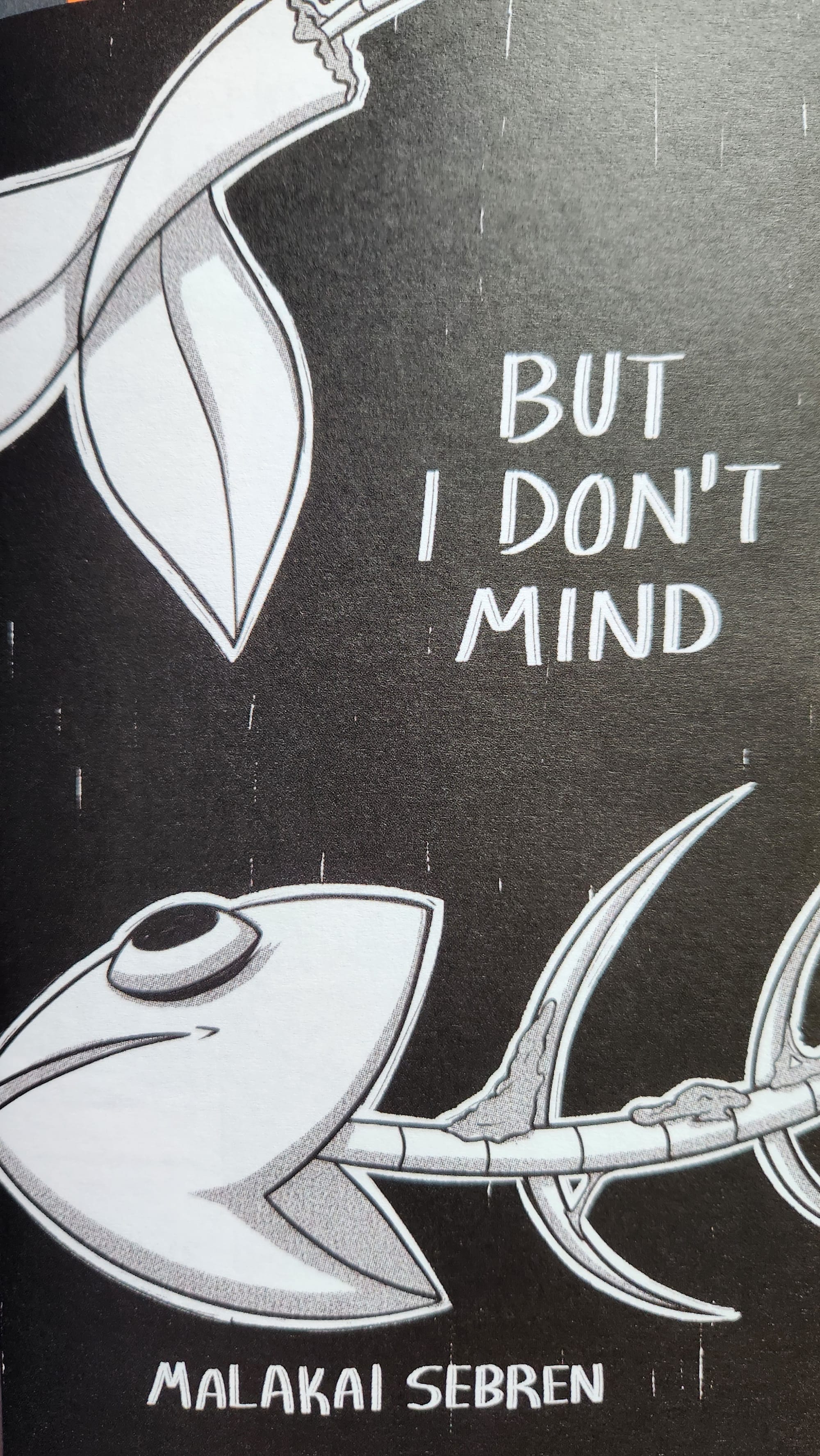
This one is particularly bleak. A rabbit goes home to live with his father only to discover something is wrong with the family. His brother is sick with a black ooze, his father fishes in a hole with inedible fish and feeds the rabbit a mysterious “familial tea,” and his father’s wife is covered in the ooze too. When confronted, his father (a fox, of course) tells him the tea is his blood and that he just wanted to bring everyone closer.
So he takes a knife to the chest in a dark but also…kinda funny panel? I dunno. Something about the way Sebren draws him, like a child having a tantrum, with the huge “HOW DARE YOU?!! I LET YOU INTO MY HOME!” made me giggle. It doesn’t reduce the revulsion I feel towards the character and what he represents in that moment.
This is a story about guilt, particularly for one who has escaped an abusive family. The cartoony “funny animals” (or I guess, furry) style characters and the supernatural goo - love that build-up with the eyes in it - helps create a distance from the real-life horrors it is depicting. It can also be a metaphor for, simply, returning home, seeing how the ones you love have been changed by the world or an immediate family member with noxious, toxic opinions. How infectious it can be.
That said, the story’s clarity leaves something to be desired. There are holes in the premise and the language used that imply a lot but are never resolved. For example: page one talks about how our protagonist never had a relationship with his father, but later on it seems like he never met him before?
I assume that the father left, for whatever reason, and that this is a second family. However, “step-mom” or “half-brother” are never used, which would be appropriate for a situation where the protagonist is so distant from the family. “His wife.” “Their child.” Statements like these make it clear this isn’t his childhood home. (“The house held” is also a fun little typo. Appropriate.) It nags at the brain and ultimately detracts from the themes that are present.
I have other questions that speak more to Sebren’s strength at making a world and characters I want to know about even in such a short amount of time. I also wanted to commend the expressiveness of the characters. It went a long way to keeping me invested and following the somewhat tenuous, dream-like leaps between pages.
Designated Longevity
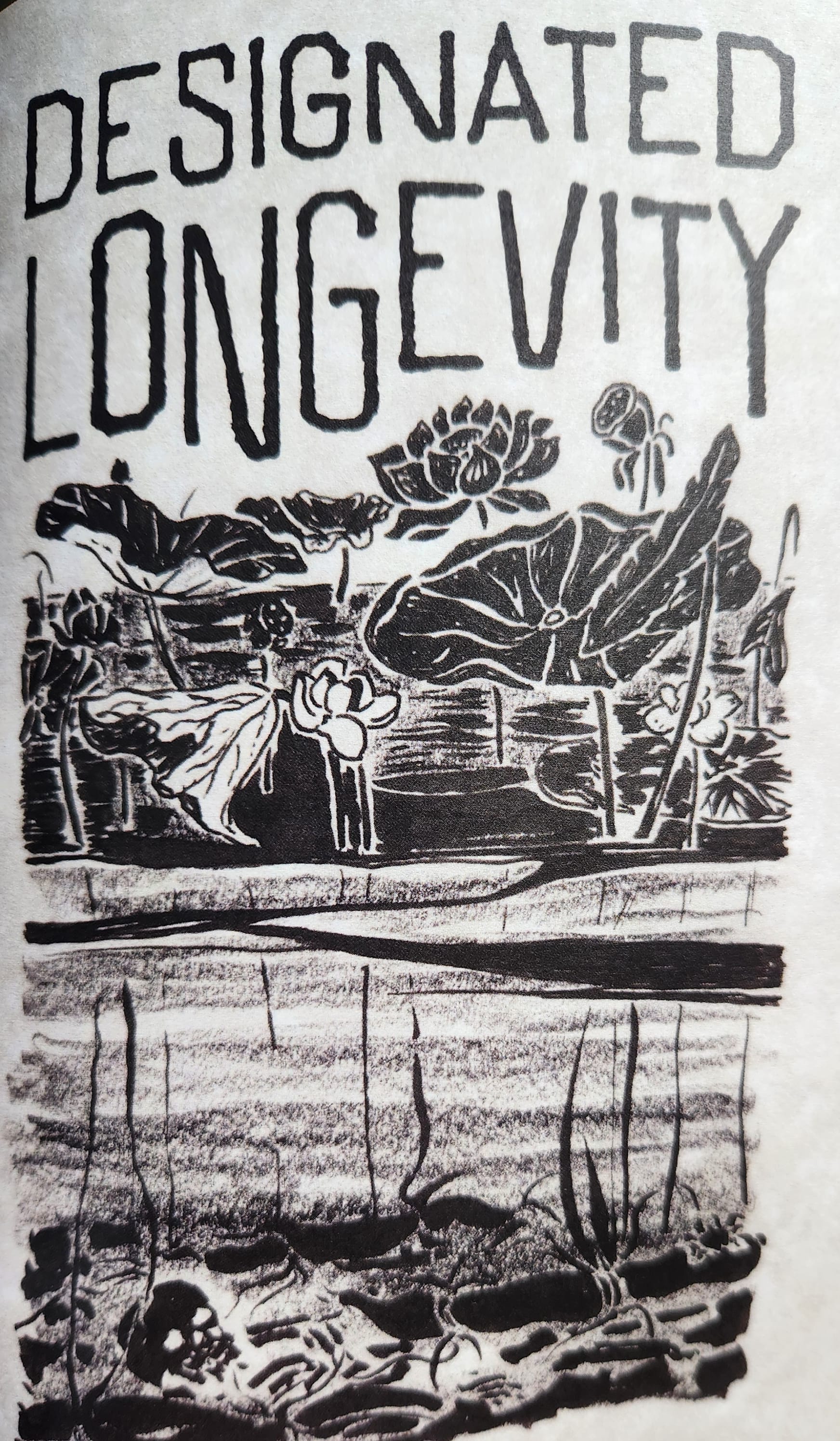
I must admit, this one left me a little baffled. I could follow the general contours of the story but the second half was a little too opaque for me to parse. I get the sense that this is a play on a (perhaps famous) Chinese storytelling archetype or even folktale from the way Ding structures the piece. Each page of the first half is two images, each with a narrative caption beneath it. There’s that oral storyteller cadence to the narration: “Kang’s grandpa favors him very much. He always has candies and toys for young kang.”
It gives a sense of distance to the events. A “back in the old country” vibe. The story itself is about Kang sneaking across a field of poppies and reporting to one of his grandfather’s maidservants that he saw a mysterious girl in a pond and that she gave him a jade . The maidservant is shocked and goes to light some incense at the water’s edge, beseeching the spirit of the girl to show her what happened.
This is where the story lost me. I eventually figured out that the girl was either Kang’s sister or cousin who was killed because of an incompatibility of destinies (BaZi) with her grandfather. The spirit then tries to kill the maidservant? Who then shifts the blame to the mother, who presumably did the deed or went along with it? And then Kang is left with a package that, I’m guessing, has birth records, a photo, and the lock. That it’s rendered in a somewhat muddy, beautifully composed night scene, only hurts the clarity of those concluding pages.
I must also admit I had to look up what BaZi (八字) meant. Context clues were enough that it didn’t really matter but I felt I should at least get a general idea of what I was reading. That I am lacking in the cultural context aside, “Designated Longevity” is a good example of a story ill-suited to this short of a format. The change in narrative style midway through, the lack of set-up for the “twist,” it’s indicative of important context being shorn for the sake of brevity.
I would like to see Ding expand this one. It has potential as a longer piece. Also I’m sure the black and white printing did not do the inks (or perhaps penciled shading) any justice. Lovely backgrounds, crushed by a scanner. Alas.
Pinecone
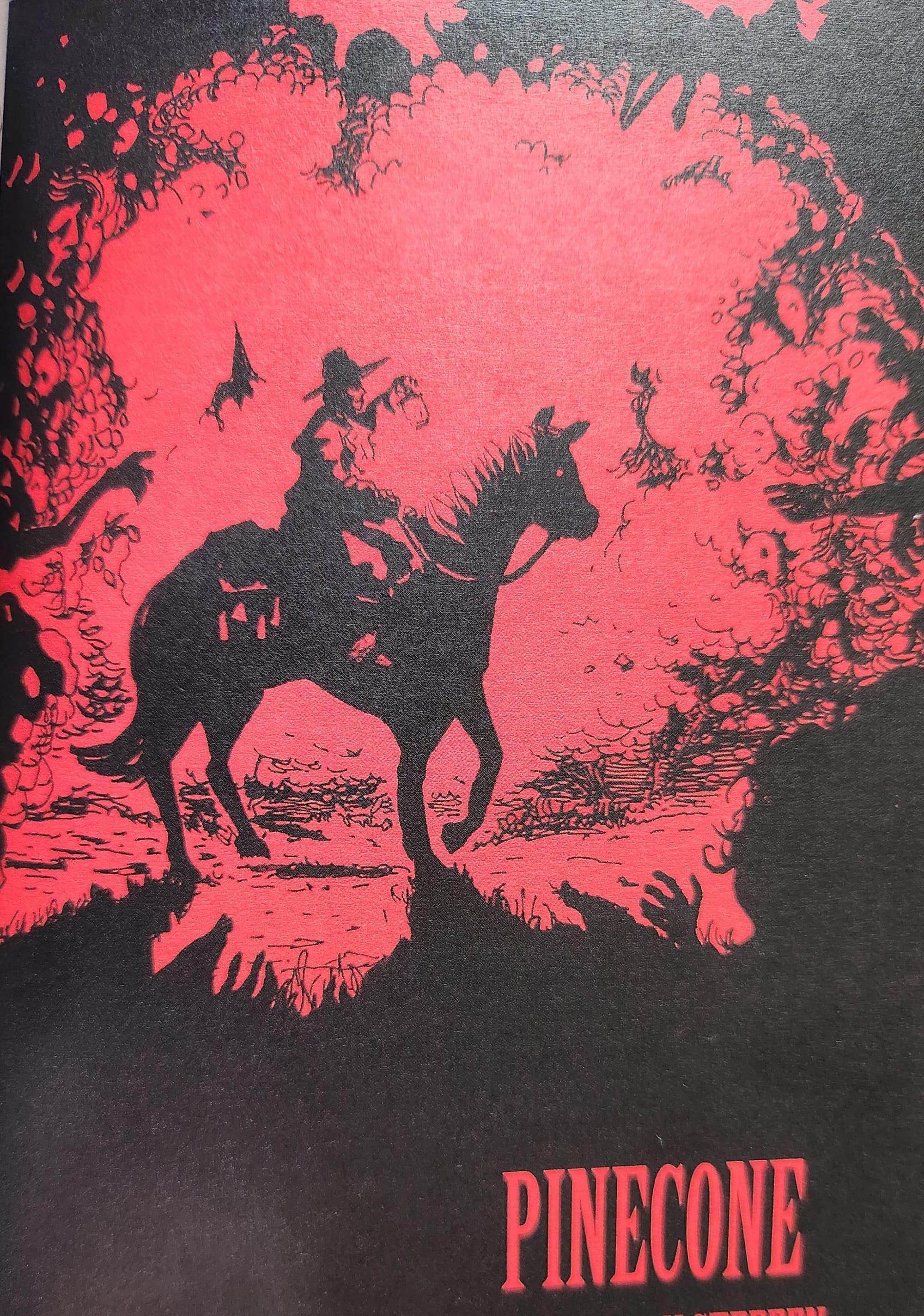
Spooky, ooky western! I’m a big sucker for an 1800s ghost story. Put someone in a cowboy hat in a graveyard with an oil lamp or candle and you’ve got me hooked.
“Pinecone” is another example, though, of a story that seems to be missing that last little bit of context to really make it cohere. We have a cast of characters and a mysterious death but the short page count means there can’t be sufficient build-up and, because we aren’t drowning the pages in text anymore (hi EC Comics,) there’s no purple prose to slow us down and marinate in the atmosphere.
Faces and clothing are memorable and we got a horse! A *huge* horse if the perspective is to be believed. Yeah, there’s a real roughness of the art in this one, a trouble with model consistency panel to panel. People are wobbly and so are the environments. Steffen also goes a little hard on the inking on René’s face when she’s with Conrad, our protagonist, in the graveyard. Those teeth will haunt me more than anything else.
It feels appropriate to the era and story, though. This is also one of two stories to use color too. I appreciate the effort, and the intent, even if it wasn't quite as effective as it could’ve been. I only noticed that the change in color is meant to show the setting sun on my fourth read through.
An establishing panel or two of the time of day, or the sun, or even panels changing color mid-page, could have made it more obvious. A subtler shift from yellows to blues, with some pink in the middle, also would have worked rather than the hard cut from dark gold to dark blue at the end. I did love the purple and red used on the final two pages though, as if we wandered into an Italian Giallo film.
Those last two pages are the standout of the story. What a great use of environmental storytelling, filling the background with all sorts of monsters and shadowed faces and ghouls. We finally understand what René tried to express to Conrad, what might have happened to Ethan (maybe,) and have a rising sense of dread as the graveyard’s spooks close in around Conrad, ready to make him their next victim.
Sorry, Miko.
Quita Chuatico and Richard Mercado
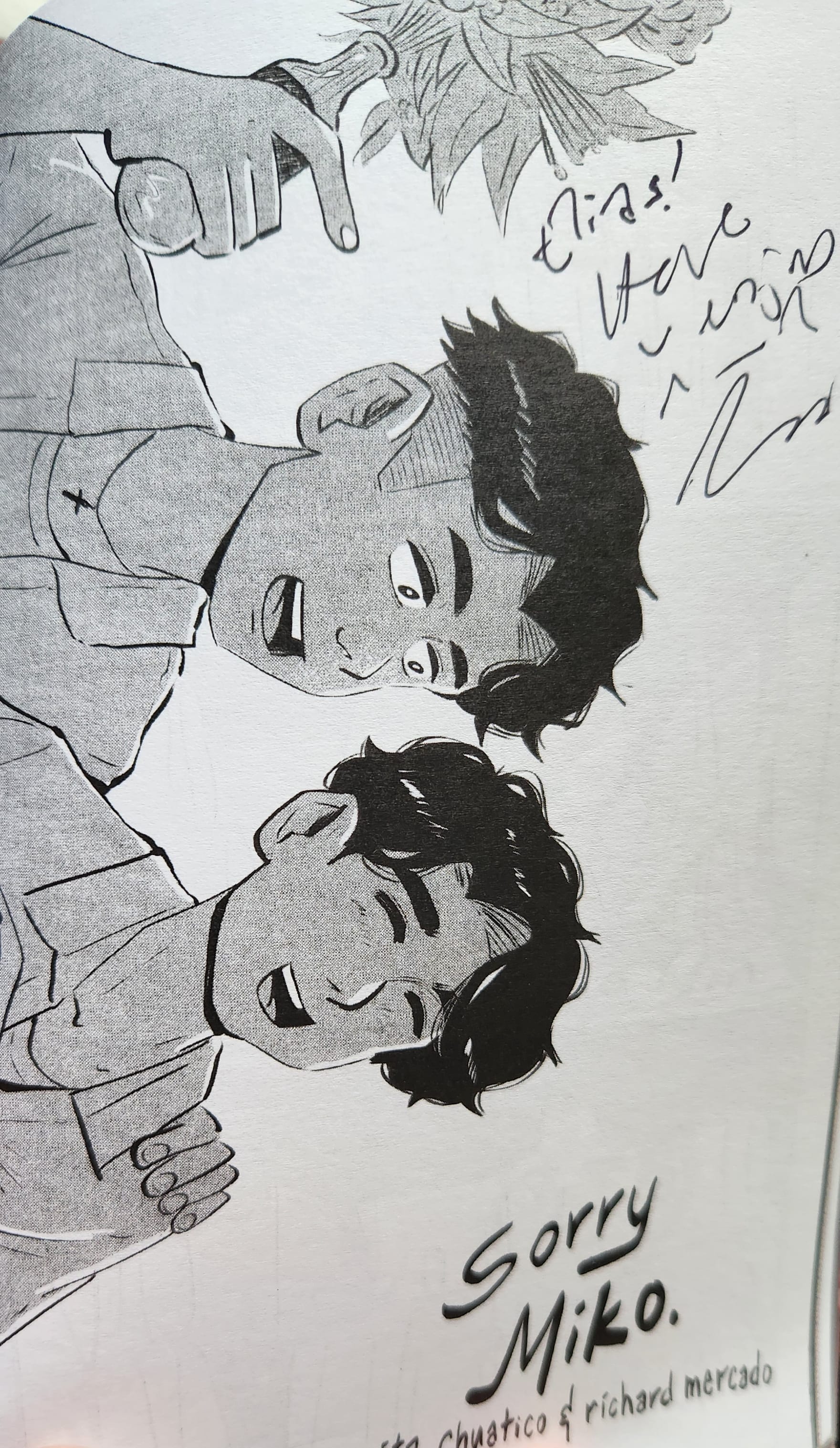
I don’t know if it’s the Dunning-Krueger effect or if it’s a sub-genre all its own but I have read a lot of “person disappears in the woods and it turns out there’s foul play afoot” stories of late. Confession is the big one. “Sorry, Miko” takes a more tragic angle, exploring the ways denying oneself ultimately harms others and the destructive nature of internalized homophobia. That Rob, our protagonist and (as is revealed at the end) perpetrator wears a cross necklace is a nice, subtle touch.
Cross-cutting between Rob in modern day going on a hike with his now wife, and reminiscing about his friend, the titular Miko, we’re shown a man in distress over his rejection of the love of his friend, a love he shared but refused to admit to himself, and the push that sent Miko to his death. It’s an effective story, well composed and told with confidence. It’s not a horror story, per se, there’s no thriller aspect, no creeping dread, but it is a tragedy and tragedies can be, and are, horrific.
Chuatico and Mercado draw this distinction throughout the piece but it’s Rob’s breakdown at the end that cements “Sorry, Miko.” as tragedy. He is not a character full of hate or disregard. He’s a person, taught by a hateful world to respond to queer love with force and rejection, doubly so when it is his own love he must reject. That this awful version of the world is being strengthened right now, with attacks on queer rights, particularly trans rights, reshaping America (and other parts of the world) is enough to make one weep.
But let us not dwell on those horrors. Instead, let’s end on love. On the tenderness of the team’s depiction of Miko and Rob’s relationship. The quiet moments of knees almost touching, of a shared coke bottle, of the sun hitting Miko’s sleeping face. It is a reminder of the beauty of love, of companionship, and of the way the world can be if we embrace it.
Rümeysa
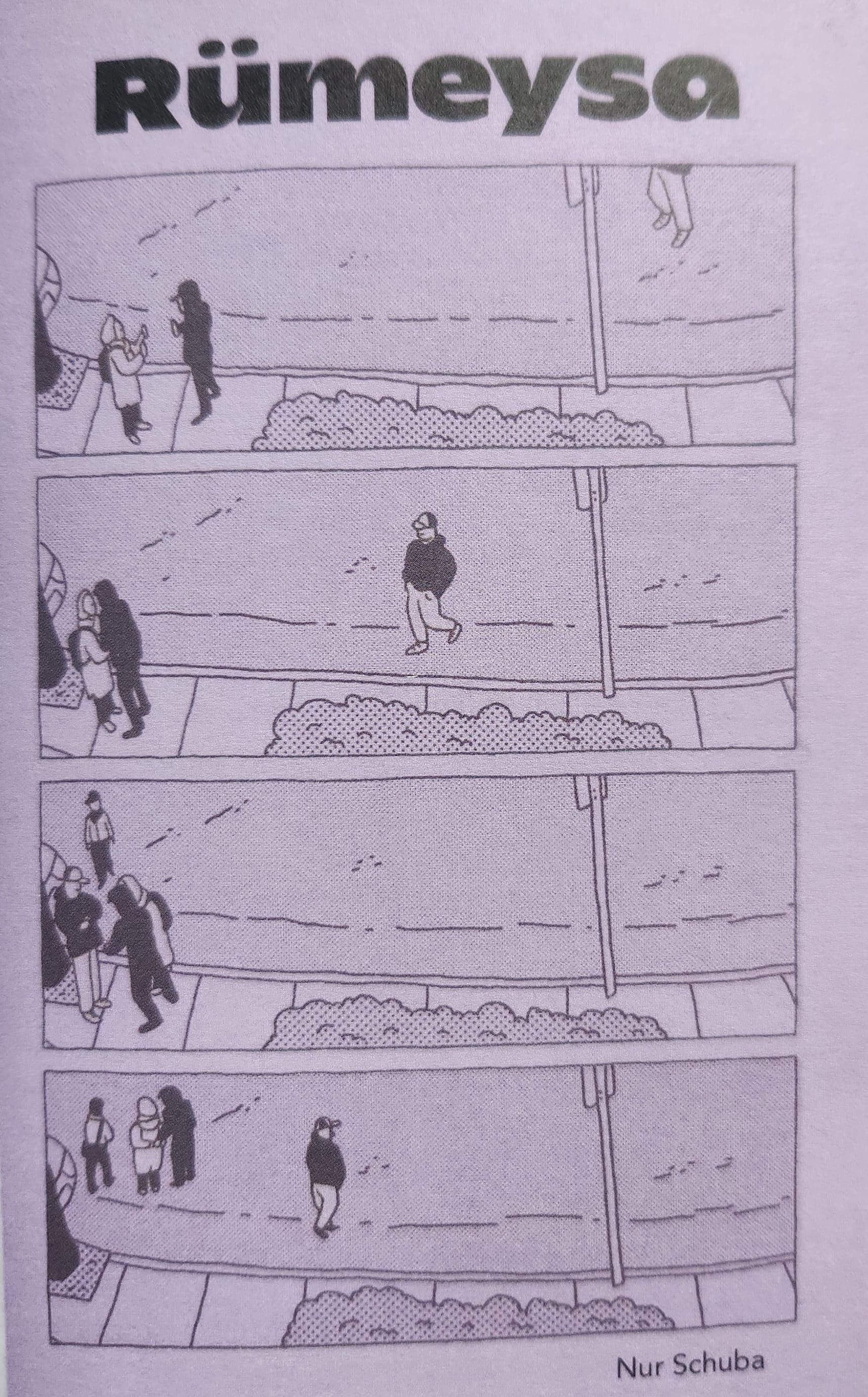
This was maybe the hardest to read. It’s a cry from the heart. Of the very real fears gripping anyone who is an immigrant, anyone who speaks out against this administration’s actions or criticizes those it likes, anyone who isn’t white or male or straight or cis or christian. It is, also, about being made to feel invisible.
Rümeysa starts with a page showing the abduction of Rümeysa Öztürk at the hands of DHS agents from the streets of Sommerville, Massachusetts. It’s an area I know well, though I am not from there. Schuba parallels her life with Rümeysa’s before expressing her fears across the rest of the story. She draws herself duplicated six, then four, then three, then one time, trapped in a box on each two-page spread, slowly fading out as she runs from an unseen adversary.
It hits. There is little more to say about the piece. It is about as personal a piece of art as it gets. It is scary because it is real and it is scary because of what has happened since.
In the year since this was drawn, and the more than a year since her detention for nothing more than writing an op-ed, Rümeysa has completed her PhD at Tufts and left the US to live in Turkey again. I wonder what Nur is thinking now. What fears chase her across those purple and yellow pages.
And what rage lies just on the other side of it.
Jenri
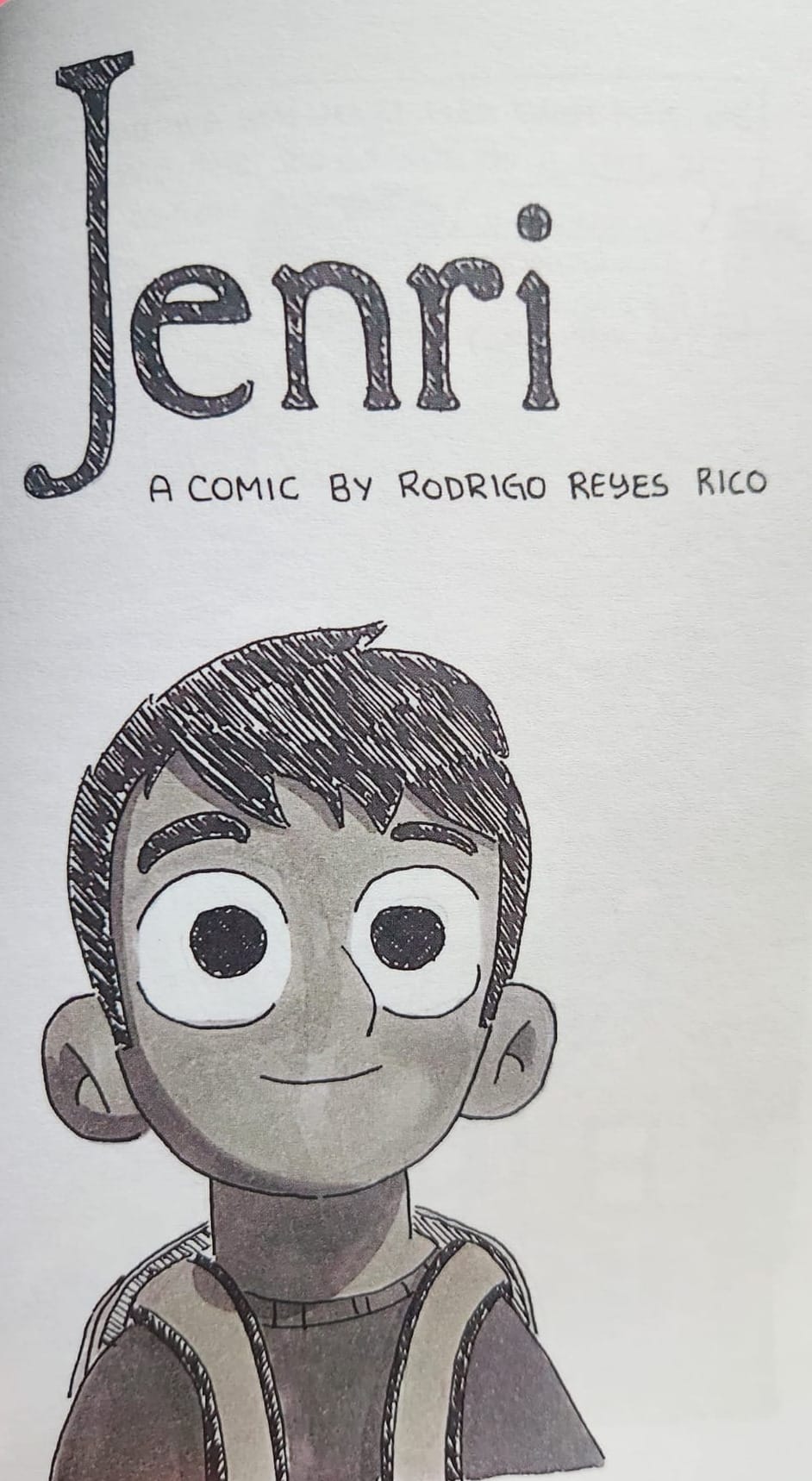
These stories were originally written and published in April 2025. Now, a year later, it’s only gotten worse. Exponentially worse. Emboldened and empowered by a cruel administration and its cruel base, more people - more children - are being ripped from their families, thrown from their homes, imprisoned, tortured, deported, and, in the worst cases, killed or left to die. We are living through a shameful - perhaps too soft a word - period nationally (and internationally.)
“Jenri” is just as powerful, just as important then as now. It makes the perfect capstone to the anthology. A statement on our world. A call to action. And a reminder of the people whose lives are being ripped to shreds by uncaring, unrepentant dipshits and their lackeys for bullshit reasons borne of hate and fear.
Passover is fast approaching as I write this section. In it, we talk about remembering that we were once imprisoned, held as slaves in Egypt. That it is our job to free others from bondage. Would that others remember that too.
 Elias Rosner
 Elias Rosner
Comments ()