Climbing the Tower: Episode 9
The Spear Bearers Revolution arrives! And promptly departs.
Originally published in “Webcomics Weekly #116: *Insert Timely Holiday Song Reference Here* (12/8/20)” at Multiversity Comics.
Tower of God
Tower of God: Season 1, ep. 43-51
Episode 9 - “The One-Horned Ogre”
Updates: Mondays
By SIU
What do you desire? Money and wealth? Honor and pride? Authority and power? Revenge? Or something that transcends them all? Whatever you desire—it can be yours if you climb the tower.
We’ve got changes galore here this week, half of which were necessary to ensure that the show didn’t end up with Shonen anime-itis, wherein the decompression of the comics is translated to the screen, the other half being born from the usual confluence of a tighter telling of the same events and stronger character consistency.
On the character end, Hoh’s greater level of cynicism and the choice to keep the letter’s contents secret means that Tower of God is able to keep his ultimate motives and actions a secret until the reveal in “One-Horned Ogre” whereas in “Tower of God,” the dramatic irony is in favor of the audience, allowing SIU to play with the idea of “multiple betrayals.” This is why his departure from Serena plays out differently in both, with it more abrupt and worrying in the show, whereas in the comic we know what’s coming, and Serena sees Hoh run in the opposite direction, which builds anticipation but not necessarily dread.
It also affects the way the climax plays out, which I’ll get to later because HOO BOY was I in for a treat. As far as which works better, while I like the mystery of the show more – it’s a better fit for the format to build and release tension – both work fine for building a secondary tension in an arc with a lot going on.
Quant is less flippant in the comic and more serious whereas in the show his constant need to be the jokester shines through his quick temper. He’s still able to get “serious” but it’s underscored by a rage and impatience that isn’t in the comic, which in turn drives his choices in the climax, as well as in a scene played for laughs that completely changes the finale.
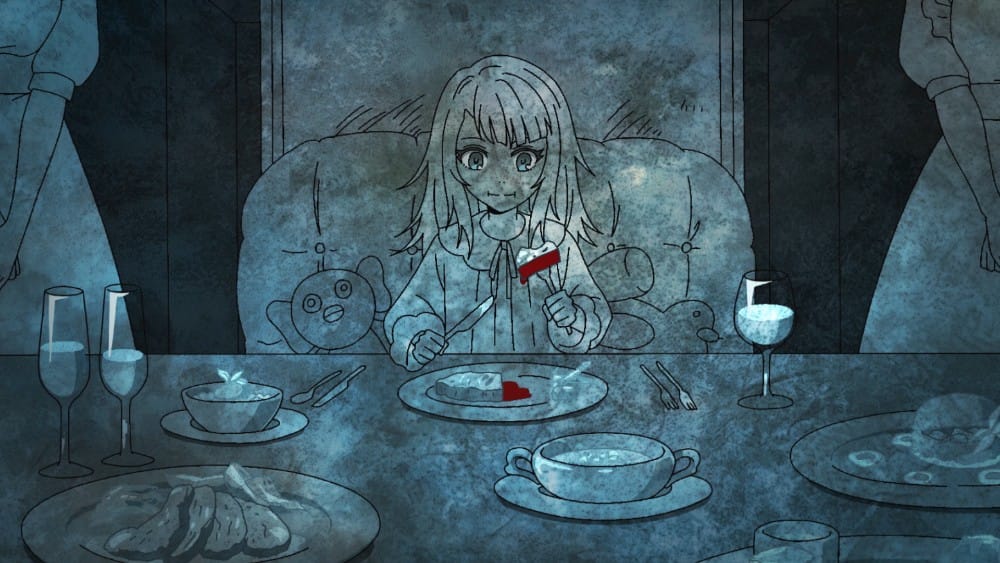
One other change I’m gonna talk about before pivoting to the finale is in the way Endorsi’s background - and her "family's" meal-based placement system - is given to us. In the comic, it’s, unsurprisingly, dolled out over a longer period of time and a lot more directly. It’s delivered in the first person straight to Bam and, most importantly, includes the detail that she beat someone once, got a taste of the table, and then maneuvered to take over the rest. In the show, it’s told almost like a storybook, entirely in the passive third person, with a tantalizing lack of concrete details, which forces you to read between the lines, the visuals reinforcing the messages or supplying an impressionistic detail that allows one to gather what isn’t being said.
A red piece of bleeding meat in a sea of blue stands out even more when accompanying the words “but from a certain day forward, she was able to enjoy everything and eat all the food herself.” “Eat all the food herself” does a lot of heavy lifting in that sentence and makes her “confession” far more sinister. Rather than being a person of greed and jealousy, who wanted more once she had a taste, she’s a person of conniving spirit, driven by hunger and desperation and shaped by her situation to see destruction of others as the only path to the top.
Endorsi in “Tower of God” is also less aloof and elitist, a fact that’s conveyed in the change in how she tells her story in Tower of God, where the edge her story has is clear from the start while in “Tower of God,” that edge only really creeps in when she takes out the other fishermen, showing off her needle and thread weapon that’s not in the show at all. That choice to split it across the chapter works because it’s a comic, and I like that SIU withholds that revelation until later, though I find it more effectively conveyed in the show, helped in that her betrayal occurs at the end of last week’s episode instead of happening after she tells her story.
Making that change also cuts out an extraneous scene since Bam & Endorsi’s conflicting approach to competition and strength is highlighted in the subsequent scene and we don’t need to have it introduced with Bam being self conscious. That’s not really who he is in the show and it makes the conflict afterwards feel like more of a battle of worldviews than of swords and weapons, which is far more interesting in this context.
This is further reinforced by the other changes to the fight that are made, the severe reduction in back and forth (and the importance of the other characters) and Endorsi & Bam centering their conversation more around the ethics of what she’s doing and questioning what Bam wants versus what Rachel wants. Rachel’s presence in Bam’s mind is also increased in the show while his uncertainty is more apparent in the comic. Knowing he thinks “what’s so special about the stars?” but not caring because it’s what Rachel wants is central to understanding his thought process in the comic whereas in the show, his devotion to Rachel is more dependent.
OK. That’s enough character introspection. Let’s get down to brass tacks because the sheer amount of plot threads and motive trees “The One-Horned Ogre” throws at us is crushing, and that’s nothing compared to what’s happening in the corresponding chapters. All the changes above affect the climax of the episode but there’s one scene added to the show, ostensibly being one of the only comedic scenes of the whole episode, which manages to make everything from when Hoh gets Rachel out of her lighthouse to the end of the episode/chunk of chapters different.
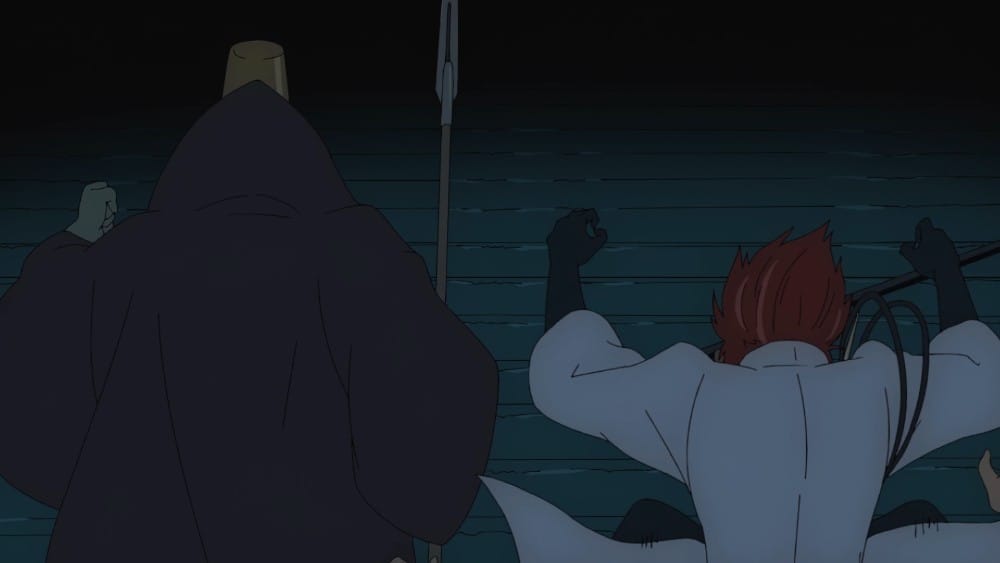
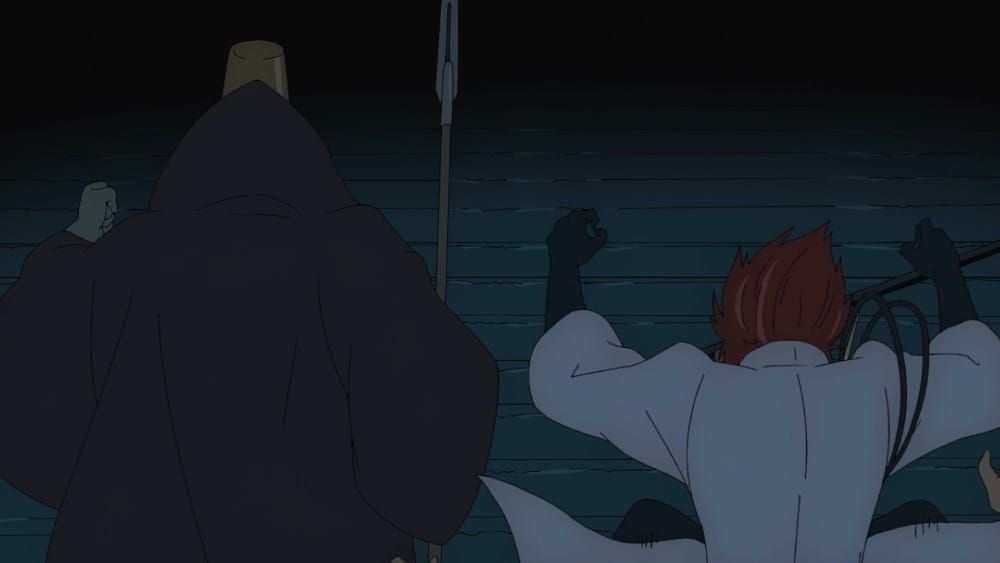
That’s right: It’s the fucking Spear Bearers Revolution.
I cannot fucking believe this was an important plot point in the comic. The show dunks on Pericule and the other Spear Bearer for their nonsense plan, one which I even pointed out eluded me last time, and then takes them out like the chumps they are, while having Quant read them the riot act. But BUT the comic? He doesn’t do that! He goes after Hoh right away rather than taking them out for messing with a plan that might have worked if not for them. Because of this, and because Quant’s character in the comic is less impetuous and prideful, the Spear Bearers are able to get away, capture Serena and another rando, convert the gunslinger I could have sworn was dead to their side, and then show up to plant the idea of fighting Quant into Hoh’s head.
It’s fucking WILD and utterly bonkers and I have to say, while it would never have worked in the show – it’s just a little too silly for that – I was having a blast trying to follow the back and forth nonsense of that chapter as well as the ways it allowed the events past Hoh’s death to change in small and not so small ways. The appearance of the Spear Bearers changes the calculus on Quant’s reasoning for leaving Bam to fight Hoh, giving him a more active roll in the scene, while also taking some of the agency and desperation away from Hoh.
Hoh in Tower of God has been characterized by his intense guilt, inferiority complex, and a feeling of creeping dread that he won’t be able to avenge his fallen family, friends, and people because he isn’t strong or naturally talented like Bam or the others. Him looking and acting like he’s been backed into a corner and is lashing out helps support his actions in previous episodes and makes it the natural conclusion to his arc; the change to why and how he stabs Rachel being the ultimate expression of this.
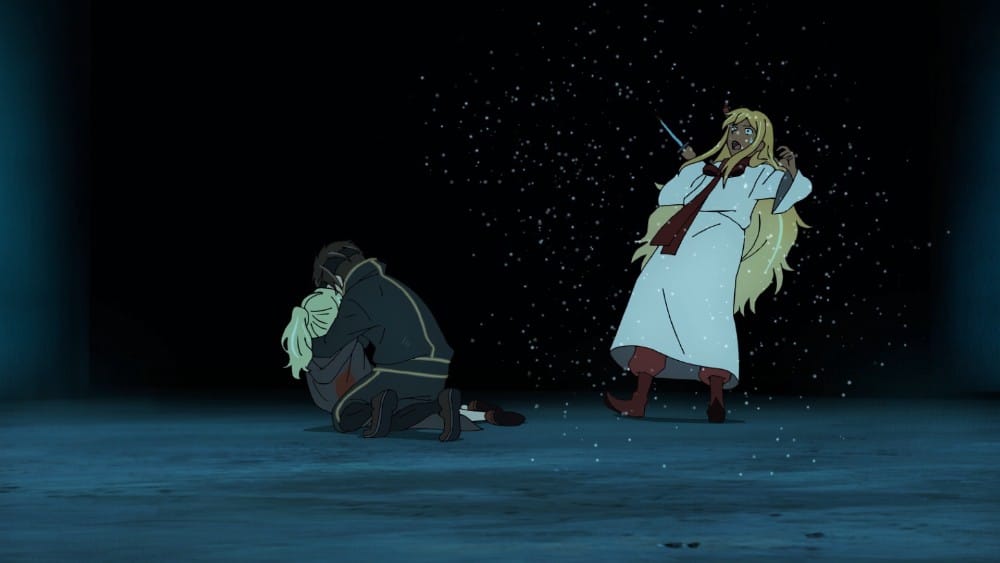
This is less emphasized in the comic, making Hoh seem more like a standard villain, complete with sneering and a more composed attitude. The human tragedy is lost, which is a shame as that’s the most compelling part of Hoh. Serena recognizes it and laments it at the end and her speech is more impactful for it.
In fact, her anger at Endorsi is more effective and powerful in the show as well because she wasn’t captured and instead was coming off the death of the one person she thought of as a potential friend. It’s a cool anger, frustrated at her betrayal as she sees Endorsi as the kind of person Hoh was angry at as well as projecting her anger at Hoh onto Endorsi. It’s a misstep to have Serena angry at Endorsi for “allowing Hoh’s death to happen as the tag” in the comic and that’s fixed here through clever writing and a damn fine job of making a single change that had far lasting ramifications.
Oh, and there’s the small matter of the “He” that told him what would happen in the show that isn’t mentioned in the comic. This bit of foreshadowing is a nice seed planted that leaves us and Hoh mostly baffled but upon a rewatch is a great way of making the arc feel a little more cohesive. Plus it explains why Quant knew where Hoh was.
There’s a lot more I could go into with “The One-Horned Ogre.” Hell, I could probably write another 2000 words on this episode’s changes and the interesting and clever ways they ensured that characters remained consistent without sacrificing the major plot beats of the comic but I’ll wrap things up for this week. In two weeks (or four, depending on when we take our break,) we’ll enter the final four with episode 10, “Beyond the Sadness.”
Last Episode
 Elias Rosner