"Charity & Sylvia"
May we all aspire to have someone say about us: "She was MOST rude to me three years ago. I have not forgotten."
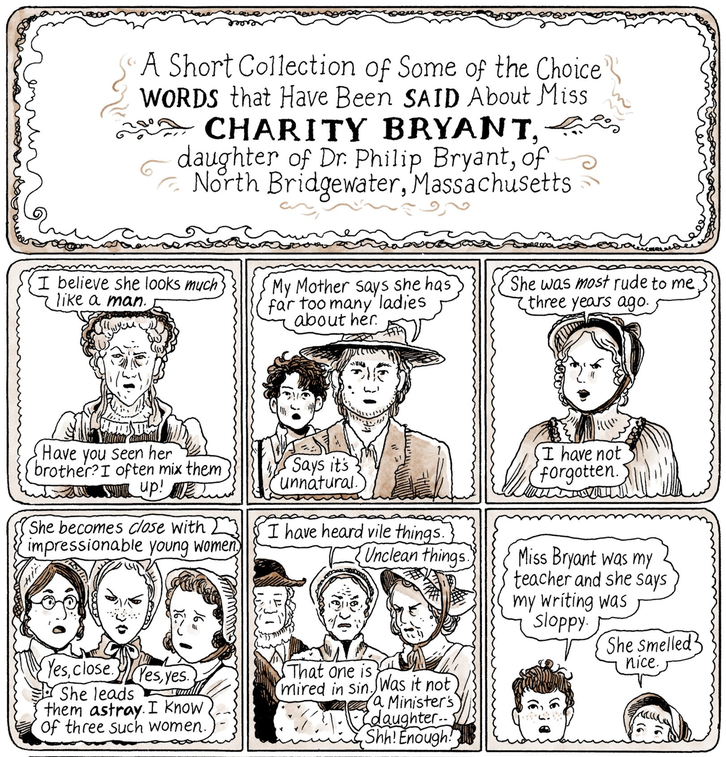
What a joy, to read a new comic by Tillie Walden. What a wonder, to hold “Charity & Sylvia” in my hand. A book designed with all the care and attention as its contents, with a cover embossed and debossed like a Victorian relief. It is heavy in one’s hands, filled with the weight of two lives, intertwined with each other, and touching so many others around them.
Can I…speak on the cover some more? This aspect of the comic that is both advertisement and enticement? That is embodiment and distraction? Can I spend most, if not all, of my space here discussing it?
Yes? Excellent.
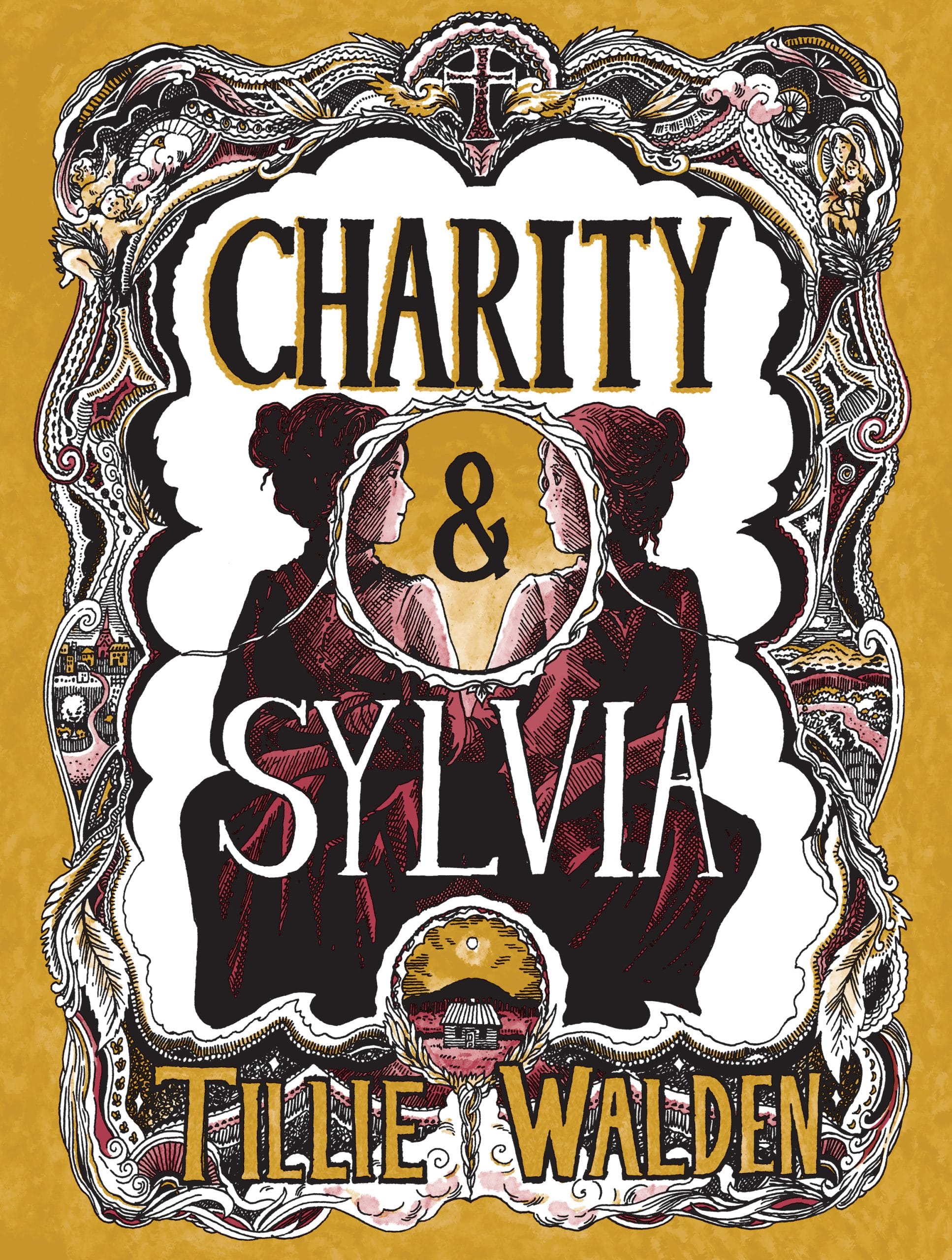
The more I pour over this cover, the more I see. The more I see, the more I am enchanted. It’s truly a wonderful piece of interpretive art; exploding out, into a full tableau, the only image we have of Charity & Sylvia: their silhouette.
What other image would suffice for a cover? This is the indelible, iconic representation of these women from their own lives - personal, mundane, deeply private lives. Yet it is not simply that image, imagined with the detail of the faces obscured by time. Rather, Tillie chooses to have the whole of them present, while still echoing the murky depths of history that has rendered which woman is which unknowable.
In this rendering, they are sitting hand in hand - Sylvia on the right, Charity on the left - Sylvia’s right reaching over and holding Charity’s left arm, while Charity tenderly rests her own right hand on Sylvia’s. They are in shadow, as if the sun were setting and we are catching a glimpse of a private moment, a moment partially obscured by the “Sylvia” of the title.
This hand-holding, this intimacy, is hidden, found only through careful examination, even as it is there for all to see. A reflection of their own sense of propriety, and the smothering curtain of American society’s struggle with queerness. Yet we see, bright as day, framed with a circle of intertwined branches and lace, the looks on their faces as they take each other in across the “&” of the title.
Look at their eyes. See the bliss and love and joy of being “and.” Not just being Charity. Not just being Sylvia. But of being Charity & Sylvia.
Then, along the border, full of filigree and leaves, are images from their lives and environment: the road out of town; the church and its surroundings; their home; a cross; angels and clouds and whittle babeh Jesus. Ornate and picturesque, acting as a frame of a painting; the final transformation of their original, simple, and, yes, flat silhouette.
This transformation. This exultation. This is what Tillie’s book does to their story. It is an exercise in extrapolation and visualization. It illuminates the people at its heart, centering their love and their relationship without losing the ties to the greater history and community of Weybridge, Vermont that surrounds them. It is as much about their home, about building a home, as it is about them.
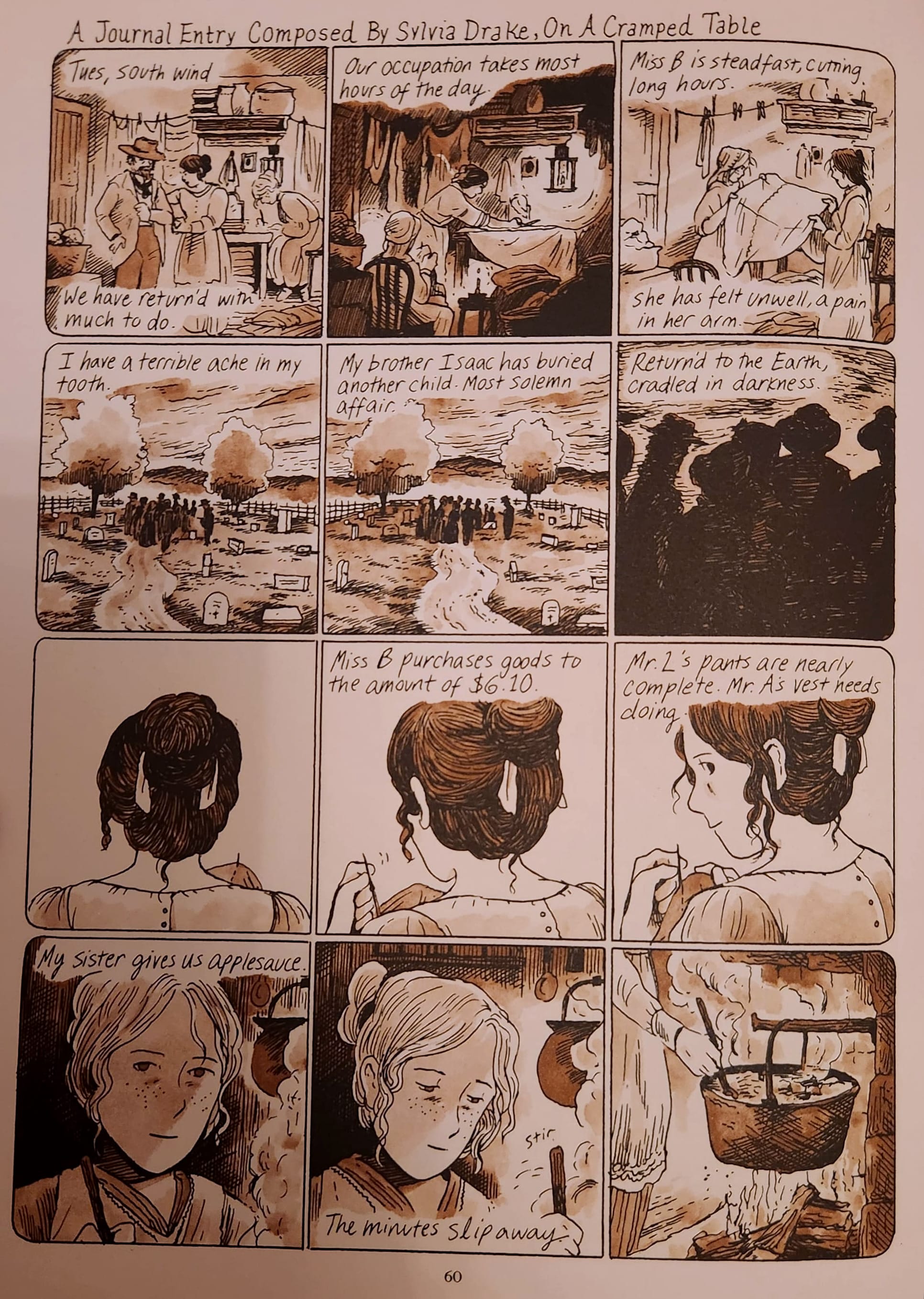
It is also a reflection of its structure. “Charity & Sylvia” is primarily composed of short, one to three page scenes, as if we’re walking through a life pieced together from fragments and recollections, which is true - there is little extant record of their biographical details or personal thoughts.
Much of the lives of these two women has been pieced together from scattered letters, journals, objects and books from around the world, though primarily from the Henry Sheldon Museum where Sylvia’s journal and letters sent to the couple are stored. Cumulatively, we have a life; individually, all we have are feelings and snippets and impressions.
Moreover, the twelve-panel grids - rounded at each corner, colored in sepia - mirrors the rigidity of the era’s social norms and the structure that surrounds Charity & Sylvia’s lives. A structure they live within, that they find meaning in, even as they push against it in order to live together in their own way.
We see this in their deep religiosity, in their strong familial love and the love of their Weybridge community, in their support of the other women around them to live as they wish, men be damned (though they may have taken umbrage to that particular phrasing.) Far from being a rigid metronome, the grid also makes moments feel like days and days like moments. Such is life. The things that linger, that have impact, are as wide and varied as flowers in a meadow.
A kiss behind a tree as neighbors drive by; a piece of a sermon; a grocery list; the death of a beloved (or not so beloved) mother, father, uncle, brother, aunt. Niece. Some are remembered in great detail, every word inscribed on the heart; others, flashes and isolated ephemeralities: a cup; a smell; a bench; a color; some thread.
Death, too.
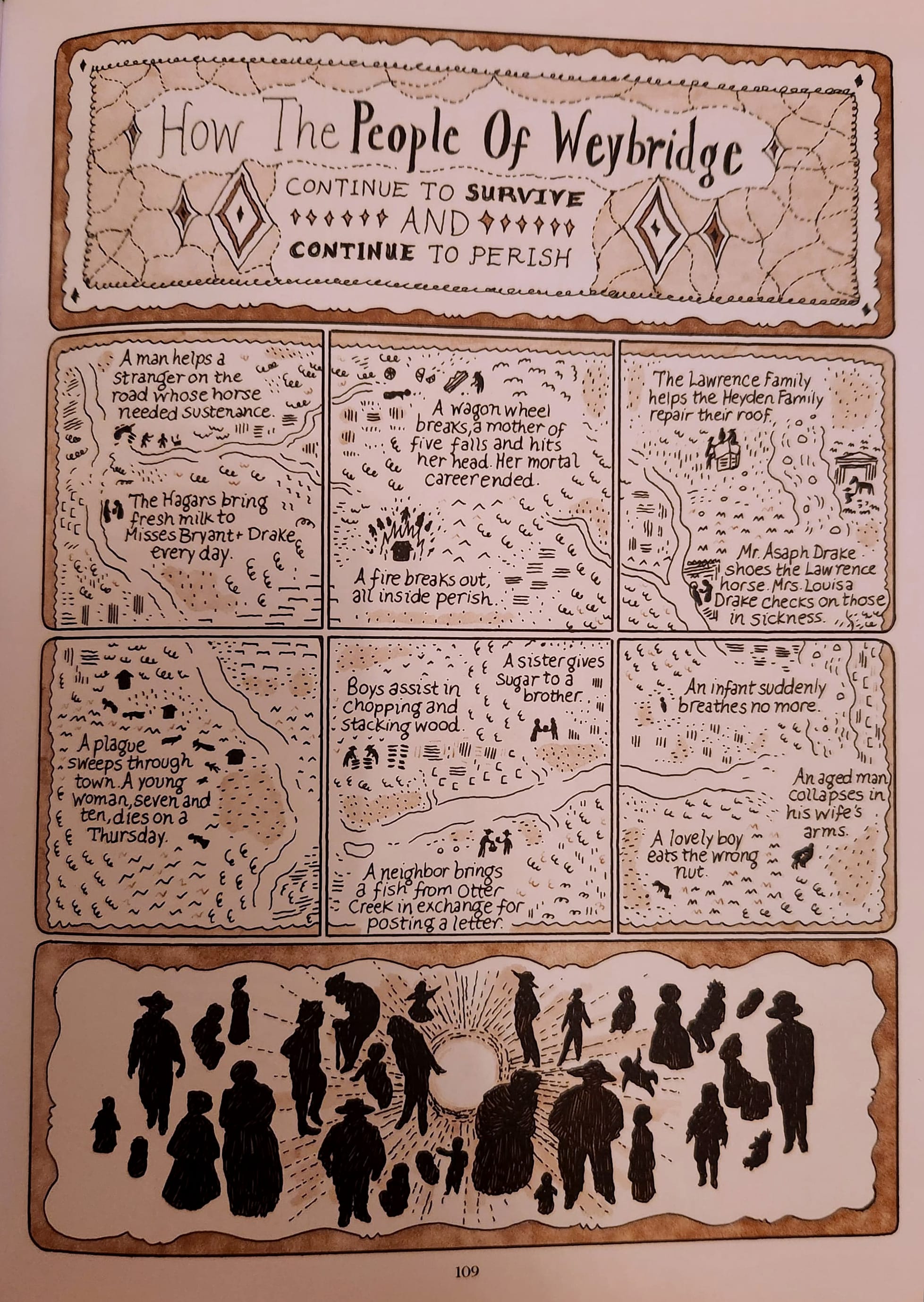
It permeates the book, sudden and omnipresent, coming for so many more than one would expect. Even knowing how many people died young in the 1800s, I was not prepared for the sheer volume of family members and friends of Sylvia and Charity’s who die over the course of this book.
Many of these deaths are conveyed through single-panel tableaus, such is the mundanity of it all, while others are presented with more pomp and gravity. This isn’t to say those other deaths lack gravity within the book. Tillie treats these deaths with the same level of respect, even Charity’s father and step-mother, spiteful towards their daughter as they may have been.
But some simply hit harder than others, leaving me a blubbering mess, trying not to stain the pages as I turn them. Truly, page 117 transforms my eyes into oceans simply by looking upon them. The closeness that the twelve panel grid forces upon us makes these scenes all the more effective, as Tillie puts us right with the characters, their faces filling the frame, keeping us tight on the raw, complicated, delicate emotions that she is so good at conveying.
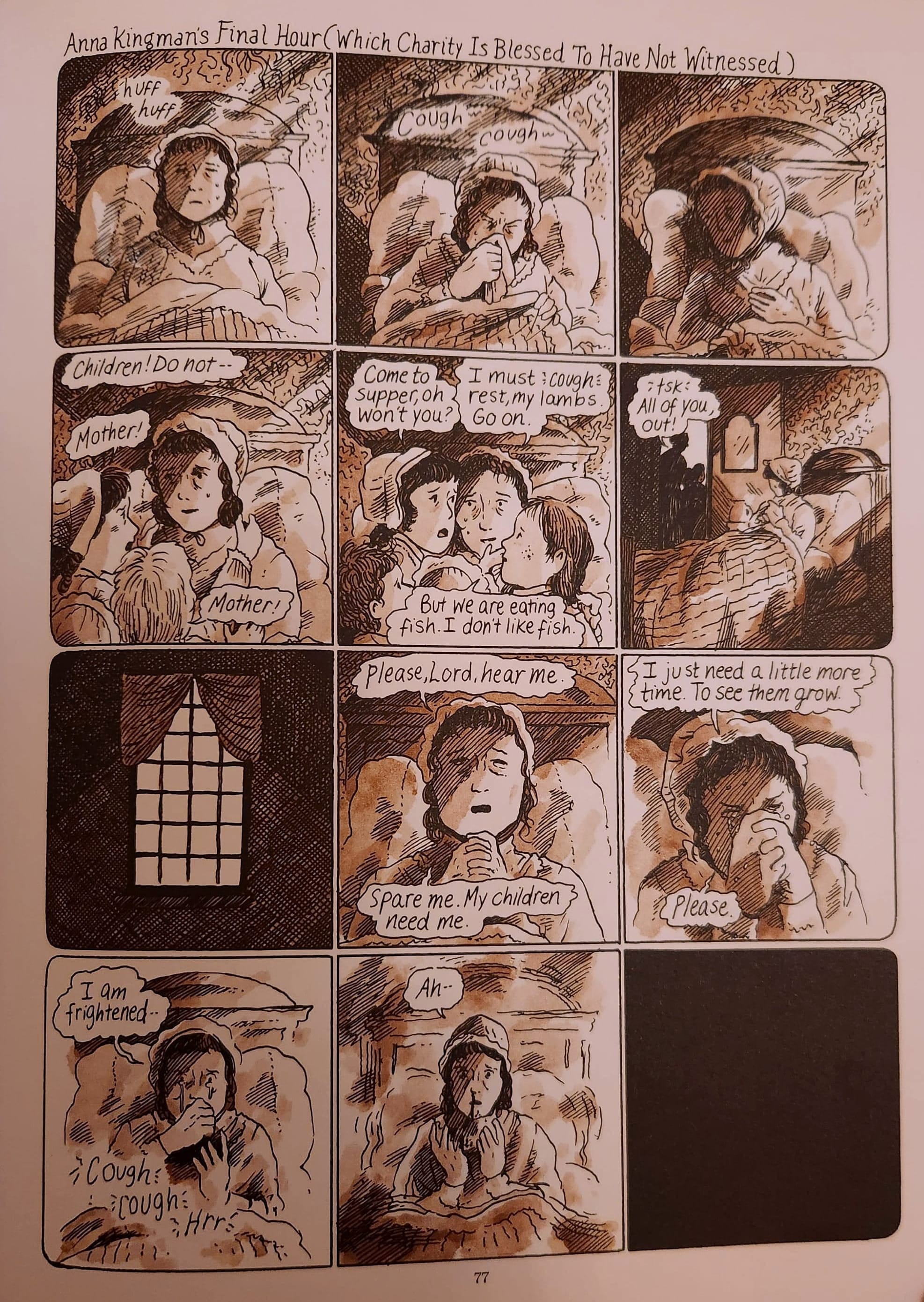
All of this is what makes “Charity and Sylvia,” to me, such a powerful work. It is spectacularly presenting the mundane but a mundane that is spectacular to us here in 2026. I am talking about the acceptance Charity & Sylvia built and found as a queer couple in the early 1800s, yes, but also on these simple things that Tillie chooses to spotlight and focus on.
Life in the 1800s, life right after the Revolution, is so different from now in profound ways. The past is a foreign country, L. P. Hartley noted in “The Go-Between,” a fact this book confronts us with, even as that quote also reveals the ways in which the past feels more distant from today than it actually may be.
Because, this book, this tome, is not merely a biography of two lovers from the early days of America’s founding. It is a history of a family, of a town, of a nation. Tillie never lets us forget the contexts within which these women lived. Their daily lives. The national politics. Burgeoning women’s rights movements. The ever present reality of institutional slavery and other assorted American ills.
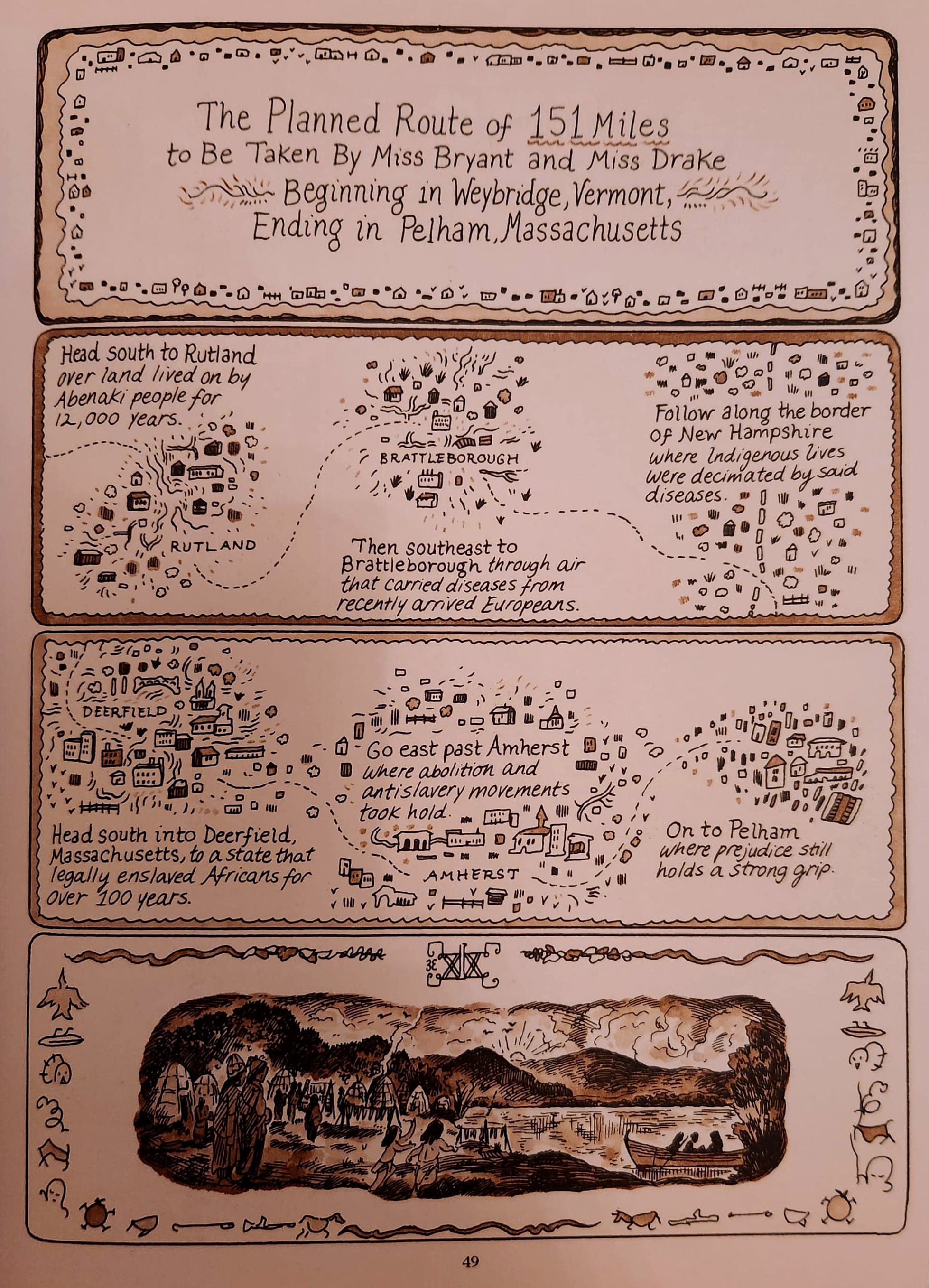
While reading, I was struck by this moment near the end of Sylvia refusing to let a young Black man stay on his way up to Maine. The refusal is presented in a somewhat (somewhat) kindly manner, but carries with it a greater shame than anything else in the book, I would say, other than Sylvia’s own feelings of religious guilt over the physical, sexual aspects of her and Charity’s relationship.
Perhaps Sylvia judges herself harshly for the moral failing. Perhaps not. Does she recognize the hypocrisy we see so clearly, having read multiple vignettes where she talks about emancipation and abolition? Or is this simply the reaction of one seeped in the pervasive miasma of racism, unable to see through its haze? Not a malicious reaction, but a damaging and harmful one all the same. We do not know, and as Tillie expanded this scene from a small, single line snippet, we cannot know.
It is an important vignette, however, as it is a more unvarnished showing of their human failings. Tillie’s comment on the top “there were two unoccupied bedrooms” frames the judgment from our perspective yet does not overly moralize. This is what happened (in the broad strokes.) Do we not do the same, in other ways, in moments of weakness?
On the eve, as I write, of the 250th anniversary of the signing of the Declaration of Independence, I see in “Charity & Sylvia” a microcosm of this country. Its strengths. Its failings. Present from its founding and compounded by the years. A nation of faith, and a nation shackled by it. A nation of sadness, and a nation of new beginnings. A nation of intolerance, and a nation ever striving, at its best, to be better. A nation of hope, if we let it be.
Come. Close the back cover with me. Let the comic wash over us. Let their story fill us…and then let us leave on the words of Charity’s cousin William Cullen Bryant in his poem “To a Waterfowl.”
“Thou’rt gone, / the abyss of heaven / hath swallowed up thy form, / yet, / on my heart / deeply hath sunk the lesson thou hast given / and shall not soon depart.”



Comments ()