SPX Haul 2025: Reviews Part 3
In this installment: a full-length review of the short-story collection "Soft Physics."

Back in September, I traveled down to Bethesda, Maryland and picked up a whole host of comics. Some are long, some are short. Not sure if all are good as I haven't read most of them. That's what we're here to find out. As I read through my pile, I'll be typing up reviews and sending them out. Some installments might have a few, some may have one. All depends on how much I feel I need to write and how many I've read.
In this third installment, I get to talk about two of my favorite things: short story collections and science fiction.
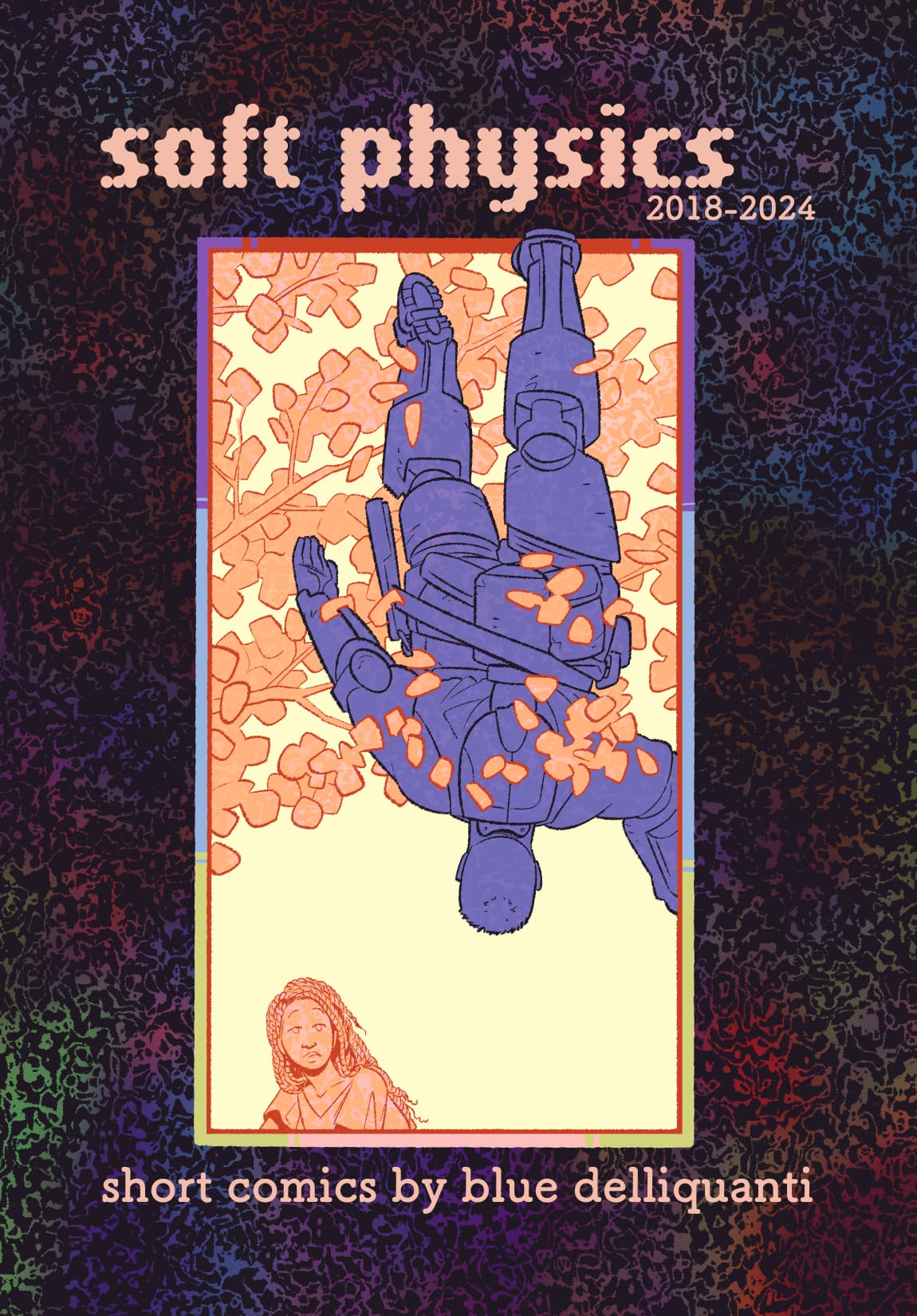
Soft Physics
Blue never disappoints.
This collection of five of their short stories wasn’t something I was originally going to pick up (sorry Blue!) All previously published in various formats - three anthologies and the Short Box Digital Comics Fair - I’d read most, if not all of them before. I own most of them, in various ways. Cynically, I bought the comic to not feel awkward standing there, taking up their time chatting. More truthfully, I wanted a reason to revisit the stories, gain some insights into them now that they’re collected, and, yes, support an artist I’ve known professionally for inching up on a decade(???) whose work means a lot to me.
Let me get this out of the way: I love short story collections. By placing each work in an order, you’re telling the reader something about those works, crafting links and inviting questions. Even if the choice is chronological, the act of saying “start here, end here” can tell a reader about one’s progression as a storyteller, be it ever upward or with troughs and valleys between the peaks and summits. I think it’s one of the best modes of storytelling and basically the only way I can think about crafting fiction for myself.
“Soft Physics,” the story that gives the collection its name, is the first of the bunch and sets a tone that’s really not captured again until “Bleed Any %.” Set in a time after the development of the faster-than-light engine, we’re given a glimpse into the internet of this far-flung era on a fairly remote planet, one built on distributed networks and packet delivery. Not really the “always connected, always available” reality of today but more capturing the promise of the early ‘net before the platforms and algos devoured us whole.
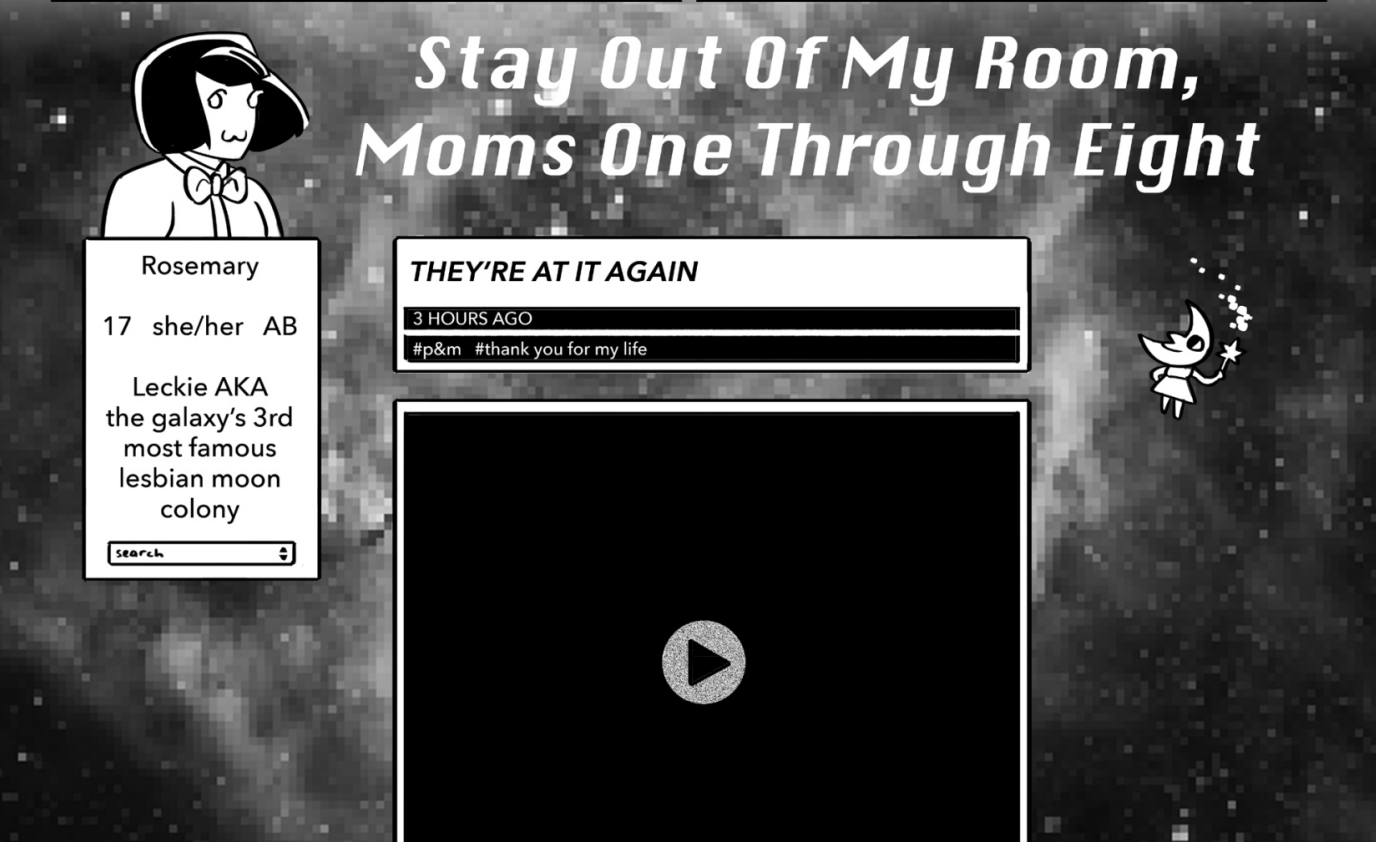
I loved this story in “FTL, Y’all” and I love it here. It’s a broad mismash of golden age science fiction wonder and modern internet nonsense. Nice a short, self-contained, as if we were one of the packet watchers, dropping in with no context save what our peers know and have saved, and only able to get this brief, fleeting, incomplete picture of these other lives. Blue’s ability to make this future not only feel possible but full is enviable.
My big quibble is the difficulty following the main narrative the first time around. The disjointed nature of the story - mirroring the packeted nature of the frame - made it harder for me to wrap my head around which pieces were packets, which were glimpses onto other planets (or the same planet,) what was happening simultaneously and which were happening later or earlier. None of it really matters for comprehension. However, it slowed me down and distracted me from the narrative itself.
Soft physics is maybe the perfect phrase for this kind of science fiction. The math checks out and the science all seems to work but in a way so foreign to how we expect things to be. It inspires wonder, beholding the breakdown of what we thought was possible and witnessing something wholly unexpected and unfathomable until we update our perspective.
“A Welcoming Party” did that too, albeit in a more personal way. Originally published in one of the “Bear Company” anthologies, it’s a very straightforward story of body mods and future cybernetics, grounded by the main character, Edu, trying to find his footing in a new space and let go of past insecurities.
This one hit home in a way I didn’t expect. Edu came from a highly regulated society, presumably also a very strict, controlling one, and he feels that he cannot ask for the things he wants or partake in the everyday luxuries beyond the essentials allocated to him. I see bits of myself in this, a baked-in scarcity mindset where, say, a sheet of tinfoil is folded and unfolded, used and reused, over and over again so long as it’s not too dirty.
Not quite the same, and not really the point of the story, sure. It still rang some bells and instantly put me in Edu’s head. That’s not what I meant by updating my perspective a couple paragraphs back, however. “A Welcoming Party” is a story celebrating the joy and beauty of large, fat bodies, and finding the strength to believe in oneself. Brell is the focal character for this, having come back with a new, all synthetic body that gets everyone geeking out over the fat distribution and the hair and the muscle fibers.
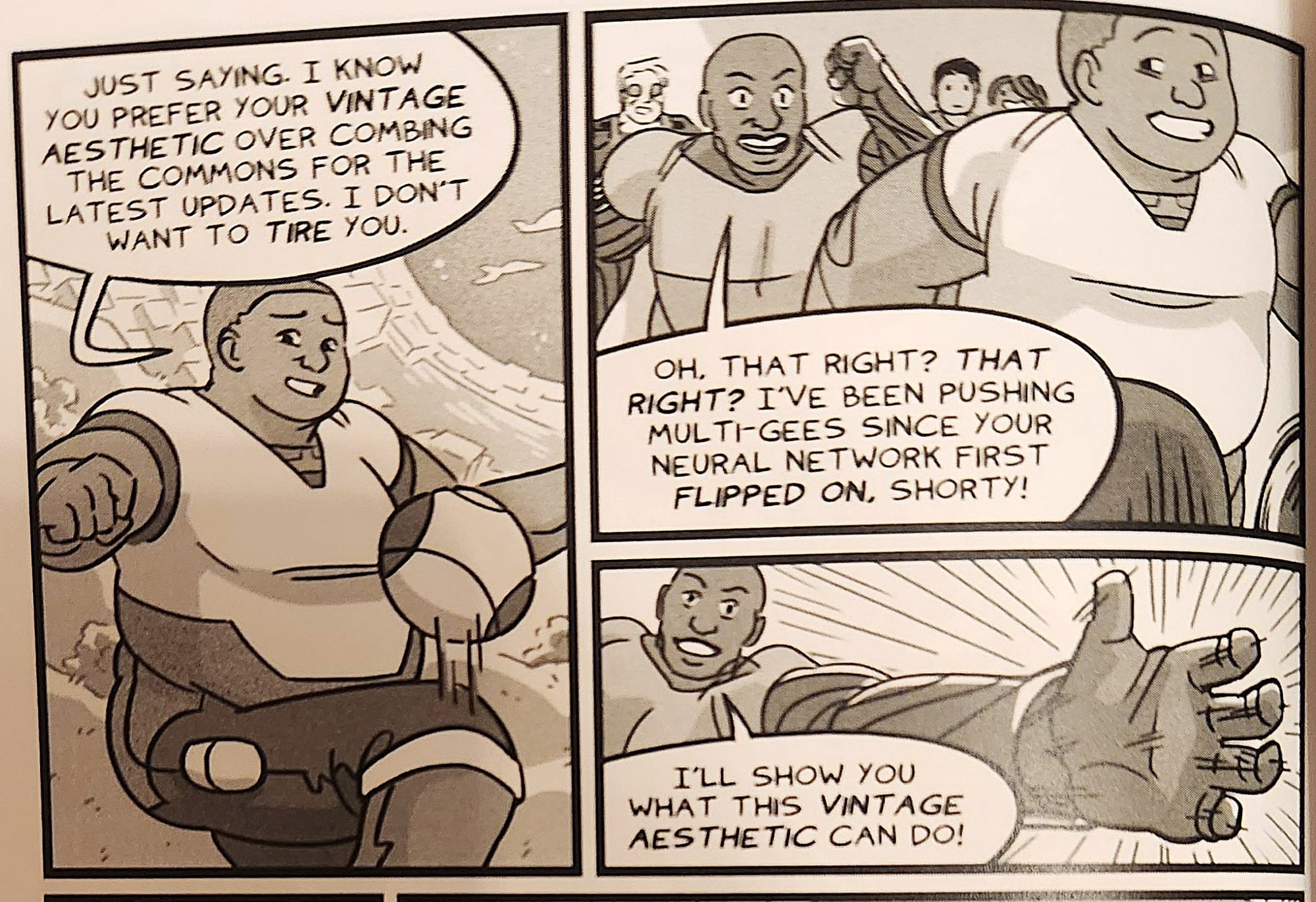
My personal feelings and fears of Ship-of-Thesiusing oneself notwithstanding, my surprise shouldn’t be the reaction I have to the story, yet it is. It’s such a small and obvious thing! Yet it took this story for me to readjust my thinking. That’s as much a condemnation of a paucity of imagination on my part as on mainstream sci-fi’s portrayal of the use of synthetic bodies.
This is what all great sci-fi - fiction, too, but sci-fi in particular - is supposed to do.
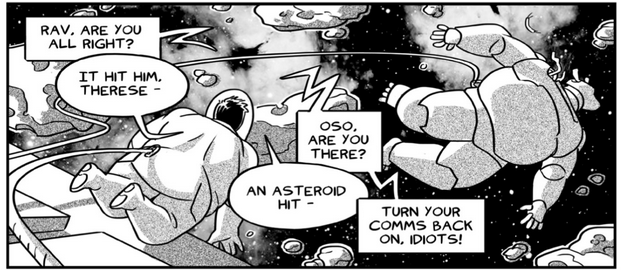
“Ursa Major” is maybe the weakest story of the bunch insofar as it's the most straightforward and simple. The story of a space hauler, Ravi, and his android crewmate, Oso, along with new pilot Therese. Their ship gets into some trouble while Ravi and Oso are doing repairs and the two’s bond is strengthened after Oso saves Ravi from some debris and gets damaged in the process.
It’s a well told story of friendship and love as well as learning to see one’s life in a new way. Not much more to say about it.
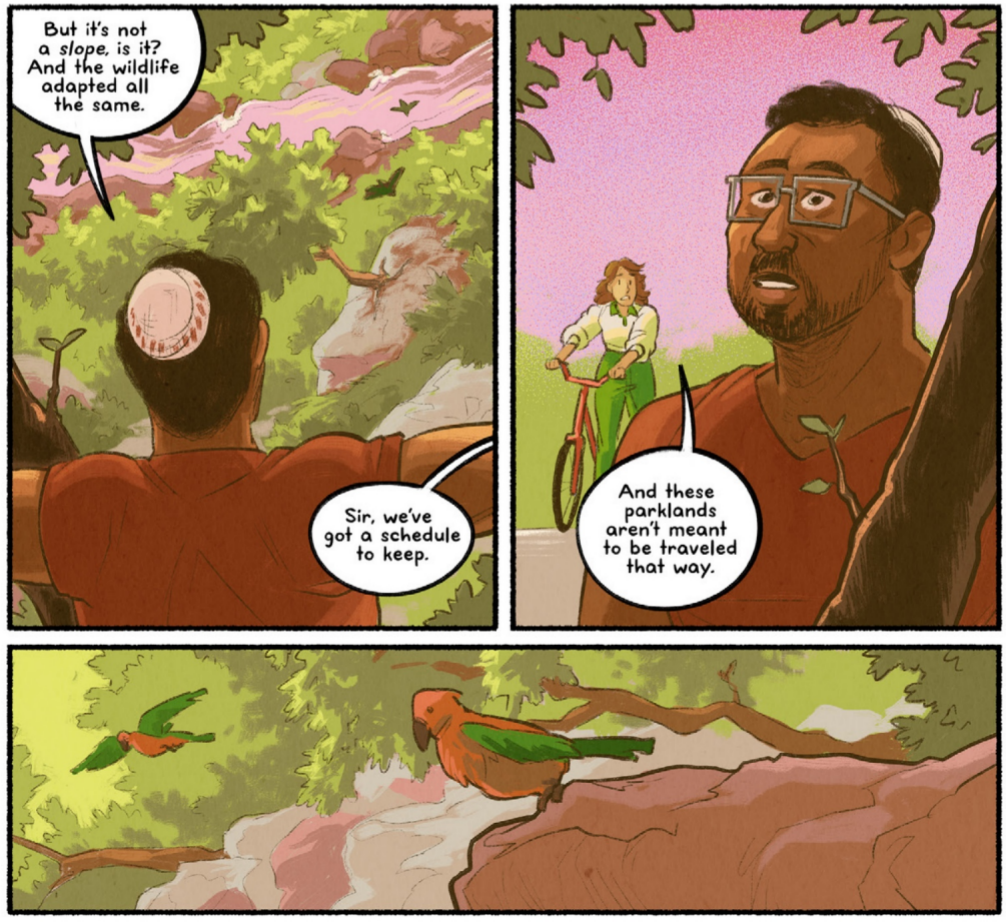
“Little Islands” shows Blue’s growth as an artist in some really interesting ways. For one, it’s the only story here in full color,likely owing to their experience making “Across a Field of Starlight” and also because the anthology it debuted in was in color versus the black and white nature of the others. For another, the comic is more playful with its presentation. More landscape shots, a greater variety of camera angles, framings which are less tight on the top third of characters.
Their characters are also starting to take on more variety, subtle changes in eye shape, nose choice, hair and face shape let the characters appear more unique while remaining recognizably theirs. It’s a little less cartoony, less rounded too. The story took me a couple reads to parse, I should add. Something about the presentation of the information was lost on me and I didn’t realize that Island Three was all an illusion, a simulation of this “better” world, and not an actual O’Neill cylinder in this future world.
Still, I appreciate its commentary on our current economic systems and failure (writ large) to imagine futures that can meaningfully be different and, perhaps, better. I’m sure it’s too dialectical for some. Not me though. I got to learn about this theoretical kind of space station, critique some exploitative systems of economics, and watch a bunch of people have a wonderful bike trip.
“Bleed Any %.” Do I like this story the most? I don’t really know. It’s certainly the strongest, and longest, of the collection. Blue really shows off with this story - made for Shortbox, so of course it’s great - and it feels so achingly relevant.
The code for an augmented reality mystery game called The Final Nocturne leaks onto the web, enthusiasts do what they do best and start making speed runs for it. This being an AR game in a future where AR is literally built into the environment - most characters shown are AR representations over their real selves & clothes, which is used to great effect in the climax - means those runs are categorized by the difficulty of the real world environment the game is mapped onto in addition to all the usual stats that gauge how hard a run is.
Samson, our main character, is doing their run in a crowded transit station (King Station, specifically, in…Seattle? Toronto?) while under constant surveillance, presumably with facial recognition, in this overly policed station. It’s a story on the move that’s about re-imagining the world around us, seeing the layers present at all times and the ways we parse or don’t parse them. Samson is hearing and feeling another reality, that of the game and its sinking ship, while seeing and feeling and smelling and hearing the reality of the station.
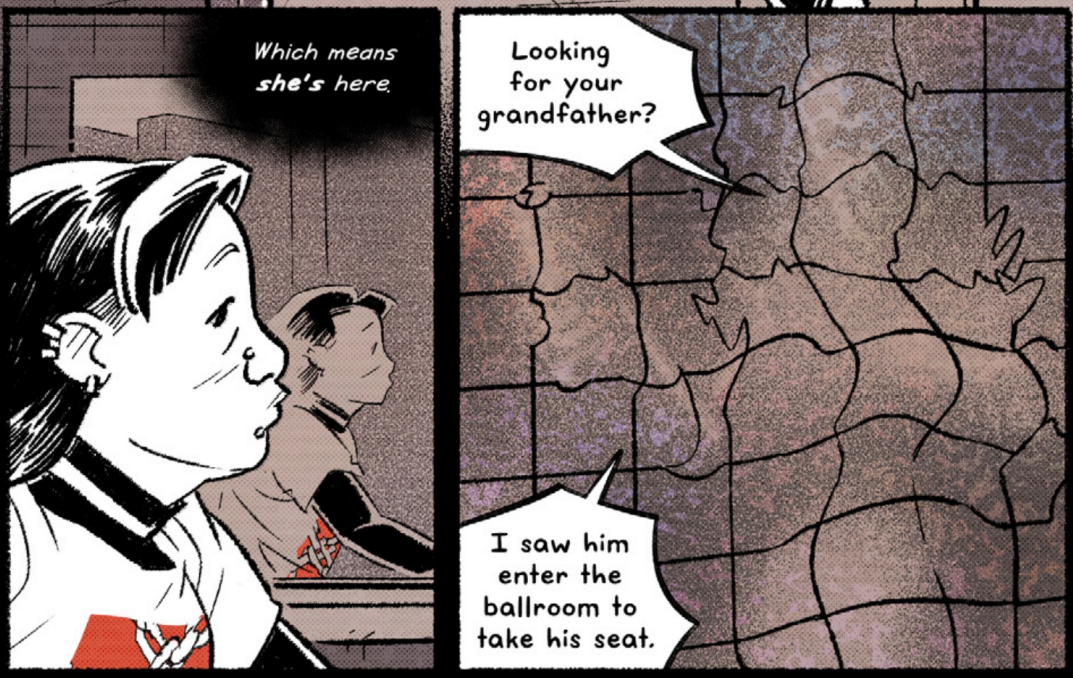
I love the way this manifests throughout and in particular in the bathroom. A voice comes from the tiled wall of a bathroom, the shape of a person forming from the distorted, fuzzy pattern, almost as if she was a living sound wave manifesting on our plane of existence. Or the moment when Samson’s breaking down another aspect of the Nocturne community, namely that of resin model creation, and Blue creates a perfect jump scare in the final panel, stumbling into “your grandfather’s body by touch.”
You can almost hear the discordant piano keys playing as they describe how the haps let them feel the pool of blood, the fatal head wound, the red herring weapon, and how much time you can spend in this important moment. I’m struck by the reverence of the moment, present throughout whenever Samson talks about the game, yet more so in these couple pages. That it’s intruded upon by looky-loos of the narc variety in “the real world” feels like an even more gross violation of this moment.
By this point in the story, Blue has been bleeding the realities into each other more and more, not because Samson is losing themself in it, but instead to better simulate the switching of perception they, and we, are experiencing that only intensifies as one gets more and more into the game.
This seems to be the core theme of the collection, actually. Perspective. Perceiving oneself, perceiving others, perceiving the world, perceiving the present and the future, the past through the future and the future through the present. Rotate what you thought you knew 90 degrees and you’ll find it’s a completely new object. Rotate it along a different axis and suddenly it’s a whole new shape. Step back and, look, a message you couldn’t see before! Put it in the light and, oh wow…
Just look at that shine.
 Elias Rosner
 Elias Rosner


Comments ()