A Midsummer Night's Pool Party: Emma Steinkellner Talks "Last Day Pool Party"
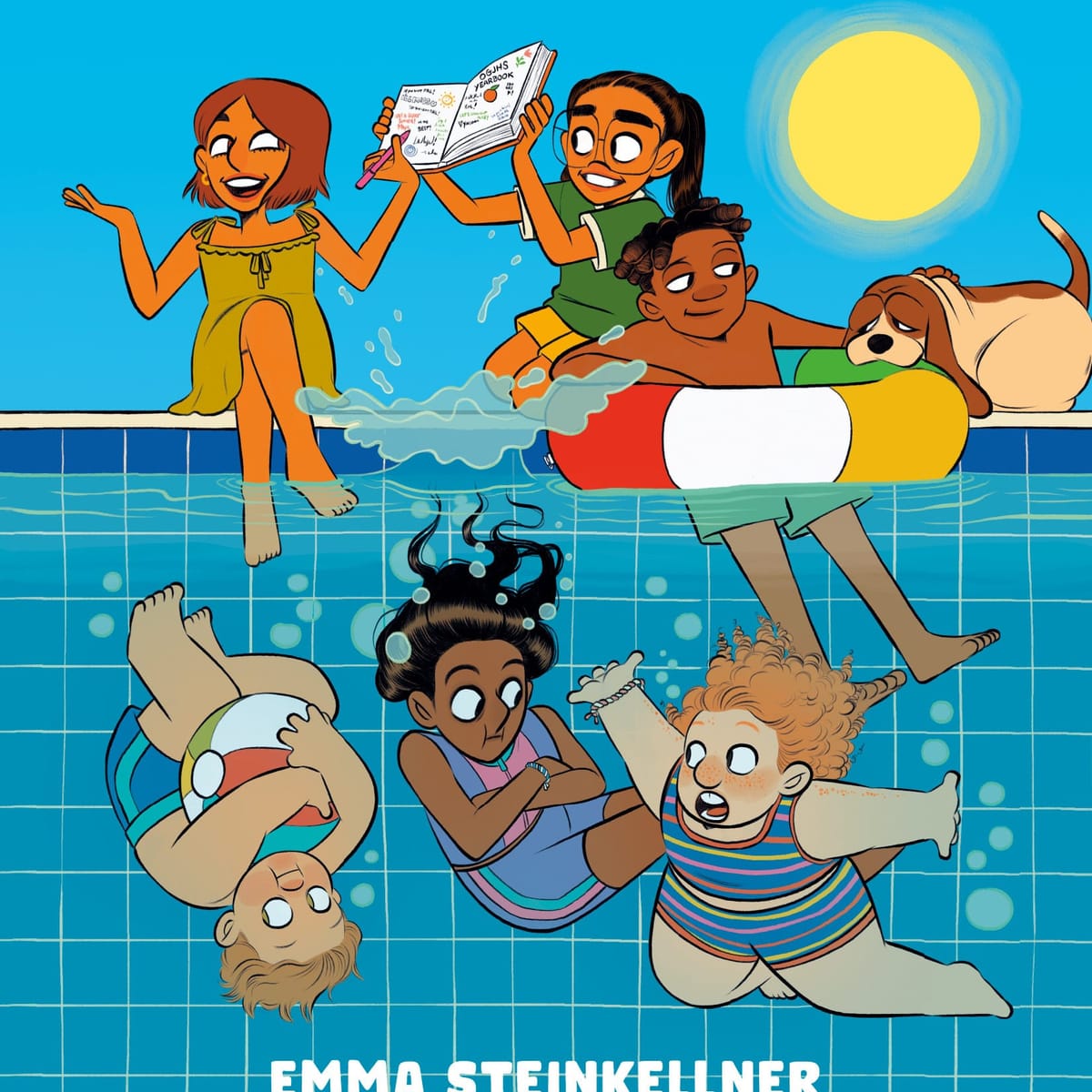
One of the great joys of doing these interviews is getting to read comics I might not otherwise pick up on my own. "Last Day Pool Party" comes courtesy of "Quince" artist, and "The Okay Witch" and "Nell of Gumbling" creator Emma Steinkellner. A departure from those series' genre roots, her new book is an adolescent comedy set, well, on the last day of middle school at a pool party!
We talked about this change of genre, how she letters and draws, as well as creating deeply considered characters that get three panels and a bucket hat to show off their stuff. Oh, and there's a hefty talk of Shakespeare as we dig into her theater background. It's a bombastic time!
Thank you again to Emma and Random House Graphic/Labyrinth Road for the opportunity. "Last Day Pool Party" is out now wherever books and comics are sold (and, of course, your lovely local library.)
You’ve been working on a few different series, a few different books. What made you decide to go, you know what? I’m going to do a new standalone.
Emma Steinkellner: That…is a great question.
[Laughs]
ES: My two other series that I’ve done so far have been “The Okay Witch” and “Nell of Grumbling.” I’ve had a great time doing continued stories with both of those sets of characters. “Last Day Pool Party” is actually an idea I had between the first two “Okay Witch” books, if I’m placing that correctly. That was always envisioned as one, or I guess six, stories that were all happening on one day but not necessarily setting up a world.
I’ve always worked in a fantasy/magic setting. In the case of “Okay Witch,” it’s the real world but it has supernatural elements. It’s a girl learning she has witch powers and finding out what to do with them and adjusting to her normal life while also adjusting to this magical part of her life. Then with “Nell of Gumbling,” these were the illustrated diaries of a girl who lives in a fairy tale world. So her normal is totally magical; she’s got a friend who’s a fairy; she’s got a friend who’s thumbsized. All this really fun magic stuff.
So it was my first time really exploring a super grounded, real-world comedy, which I was really excited about because I hadn’t done that before. Part of the reason I love to write for a middle-grade audience is that time in my life, I have so many sense memories and intrusive cringe moments that I flash back to.
How many of those got pulled into this book?
ES: I’m trying to think. There’s no character in the book where it’s like “This is Emma” but I definitely have elements of myself in a lot of these stories in being very clingy with a best friend and being unwilling to let go of that closeness or being threatened by, in this case, the best friend is moving to a totally different country - Juhi is moving to a different country - and her best friend Liv is super close, maybe a little co-dependent and she does not know what to do with these feelings. She ends up tilting in a bit of a bitter direction and holding auditions for a new best friend at the pool party.
I didn’t do that! I’ll go on the record and say I didn’t do that. But I remember at that time you would form a best friendship and that was your world. So the idea of that world being shaken up is really disorienting. Or I’ve hosted parties where I’m like “Is anyone going to like this? Is anyone going to like the things I like? I’m really putting myself on the line there.”
When you host a party, you put a lot of work into it! So I feel a lot of myself in Dustin and him putting in all this effort and him feeling like “Is this going to pay off or is this going to make me look so sweaty and such a try-hard and completely compromise me socially?”
In the case of Maia, I think it’s interesting. I feel like we look at stories around this age group, around adolescence, and we go like “everyone is fixed in their social class or clique.” The truth is there’s a lot more flexibility. It’s not a fixed power ranking. Even if you feel like the bullied person, you can sometimes end up passing that bully energy onto someone else without knowing it or without meaning to. You’d like to seem nice but you also want to get what you want.
There have been times when I’ve looked back to junior high and I’ve been like, there were times when I was goofing around but maybe that hurt someone’s feelings. I’ve never gotten confirmation but looking back, there have totally been moments where I thought: oh, they laughed but maybe they didn’t love that.
In the case of Rose…I don’t know. I’ve always sought and gotten attention so I’ve never been the invisible person.
Which is funny because when I was reading this…that happened to me.
ES: Wait. Which part? The getting skipped at graduation?
Yeah! Elementary school.
ES: Oh no! Brutal. Brutal.
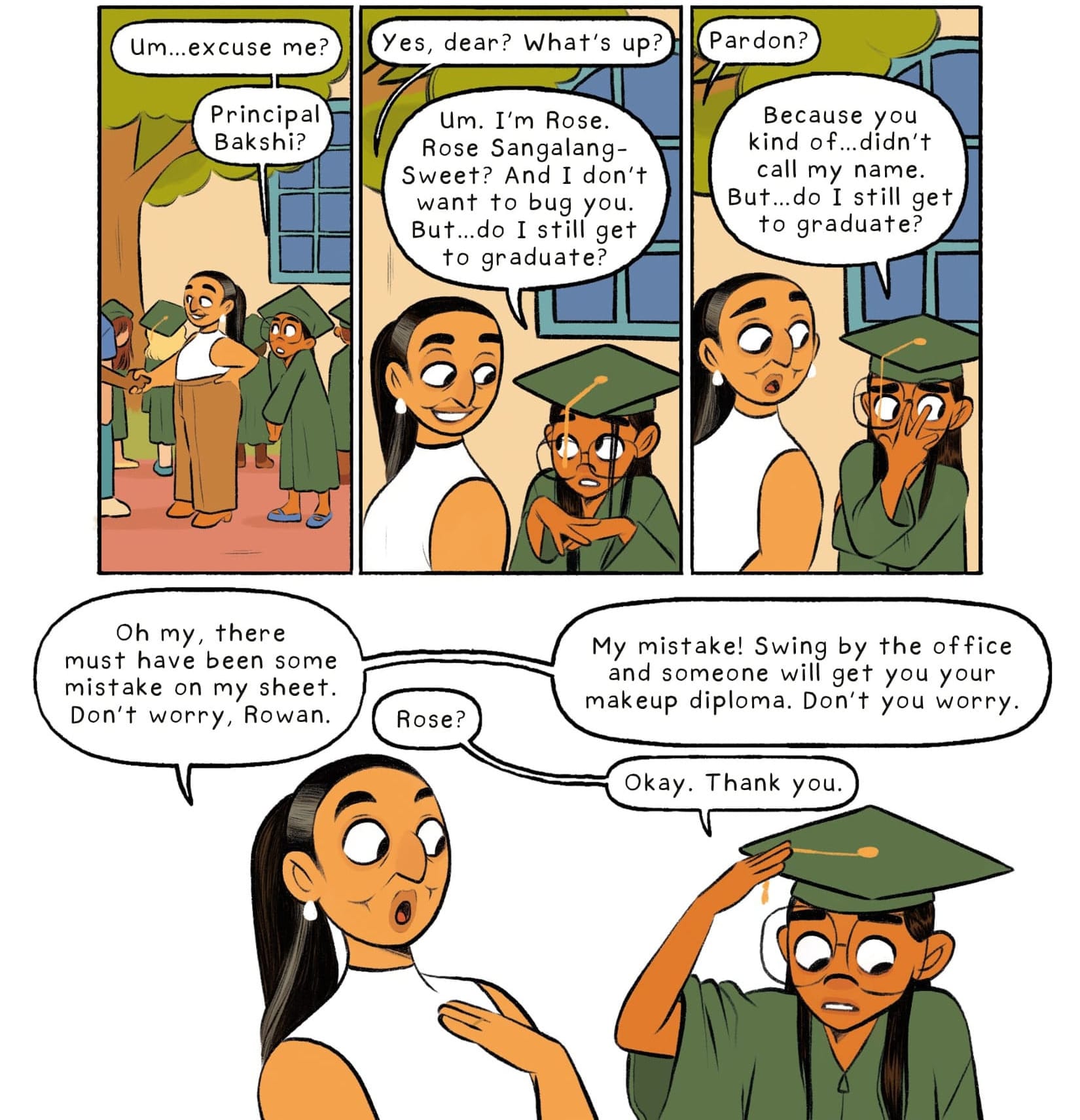
Which is nuts because sometimes they feel like caricatures. I’ve gotta have it for the story beats but it doesn’t feel particularly realistic. It is very affirming to me as a storyteller that that can totally happen to a kid! I’m sure there are safeguards in place but sometimes the name just doesn’t get on the list.
And then with Paul, sometimes you just gotta introvert. Sometimes you’re not in the mood to make any friends or interact with anybody. He does stuff in the story but I definitely wanted that point of view because I’ve been at parties where I wanted to help someone’s mom do the dishes. I didn’t want to laugh. I didn’t want to joke around.
I feel like it’s pretty plasmatic all the people you can be as a kid and it really depends on the day. In the case of this book, we’re only seeing one day. It’s only a snapshot of each of these character’s lives. I try to exercise a lot of empathy for lots and lots of different kids and their approach to a high pressure social situation or the last day of school, which always felt like a big day to me. There are just days of adolescence that have a bold identity.
It’s a capstone for, say, junior high or middle school and it’s the end of something but it also doesn’t feel like that and…yeah.
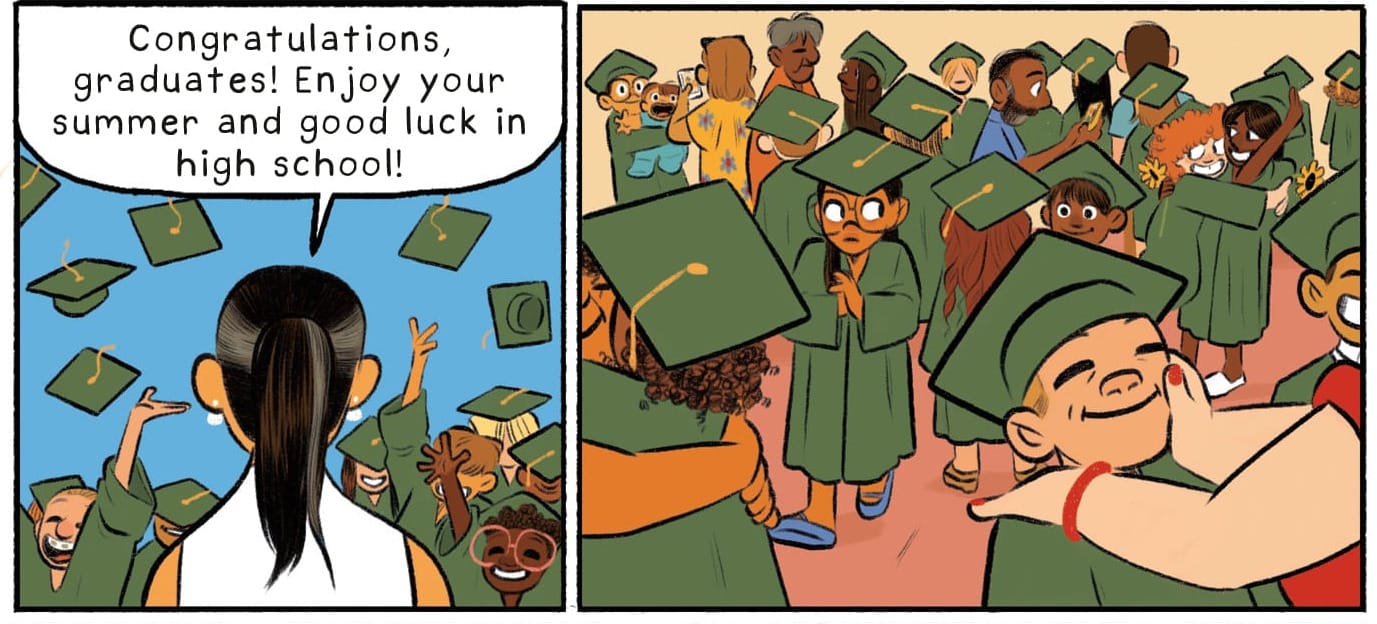
I like how much of the book is an ensemble piece. From the first few pages, I’d assumed it would be very much Rose’s story. The structure of a lot of these stories is you’re introduced to a lot of these supporting characters and then you get the main character but I really liked how much it was shared between those six.
ES: I will say: if you flip through this book, there are kids in this party in this larger ensemble of, like, thirty or forty - I didn’t count! - but there are kids outside the featured six where I totally have an arc for them that I try to convey in little glimpses throughout the background.
Like the one with the bucket hat.
ES: That one was me. Couldn’t you tell? Well, I guess you haven’t seen me in eighth grade but that was me.
I wanted to make it clear - any of these kids has a story that could be the center of this. It just happens that I picked these six to feature. But I thought about a lot of them. What’s their journey on this day? Even if it’s as simple as “I went to the party and I had fun with my two friends and we only really hung out with each other.”
I tried to keep them somewhat organized and have their behavior illustrated even if literally no one’s looking at them because they’re in the corner, half on a panel. I wanted it to feel consistent with the characters as I imagined them.
I come from a theater background and when you get cast in the ensemble, especially in a school play, you write a little biography or a story for your character. Sure, some characters get a lot of lines in, like, “Fiddler on the Roof” or “The Music Man” but my townsperson is this and these are their friends and here’s what they want. So I wanted a pretty broad ensemble to be explored because it feels consistent with the themes of the book; that there are lots of ways to have a day.
Ok. That’s not really a theme.
I mean…there are.
ES: Everyone has their own experience of a thing and you’re only seeing your part of it. In these cases, starting towards the end of the book, sometimes these characters just need to talk to each other to get a grip on their own problem; to put their own problem into perspective; to help each other to get a point of view that’s not their own or to give a point of view that someone else could use.
Because when you’re stuck in your own story, it can be hard to see that everyone is struggling. That everyone has a problem. There are proportions, of course. Some problems are insurmountable or more challenging than others but everyone’s got them. We have the power to help each other if we take the time to listen.
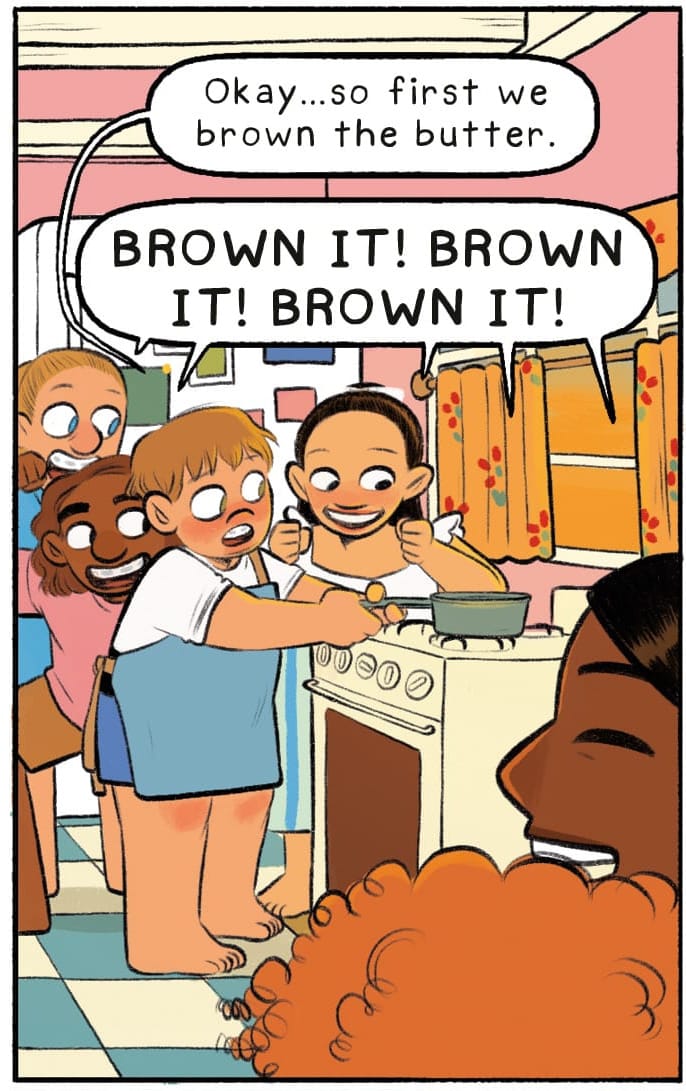
I’m thinking now about Dustin’s baking. That was such a fun arc for this character. We’re seeing the stresses of the party through his baking.
ES: Yeah! Totally. It’s a metaphor.
He’s a very, very serious baker for, what? Sixth grade? Eighth grade? Eighth grade.
ES: Well yeah. He feels like he’s walking on a tightrope because he’s had it proven he can do nothing time and time again and still get made fun of. People are primed to see him as a little bit of a joke. And that’s really hard. When that happens, he goes “well then I really gotta get this right.” In this case, it’s all on this cake. If I do a good job, maybe people will see me differently.
And the truth is, it’s probably a lot more complicated and it’s a bit of a rigged carnival game. I hope it’s really rewarding that - spoiler - at the end, he ends up making a desert recipe that’s a little more throw whatever into a baking dish.
Brown! Brown! Brown!
ES: [Laughs.] And maybe it’s a little sloppy. Maybe it’s not the most delicate, attractive confection but now he’s got kids supporting him and giving him some credit and a little appreciation and it makes it much easier to relax.
That recipe, by the way, you can make that. My fiance makes that. It’s a midwest thing. He calls it Dump Cake. It’s pretty good. I was skeptical. When he told me what he was going to be making, I was like, I don’t know that I want to eat that. And then I ate it and it was pretty good.
It does what it needs to do. I want to transition a little into your process starting from coming up with the concept and working out the characters. Once you’ve got all that settled, is it physical pen to paper? Digital pen to digital ink?
ES: It’s digital pen to the digital cloud or whatever.
Wacom tablet or something.
ES: Yeah. I do all my professional art for books digitally. It’s easiest for me editorially if I have to go back and change things, if I have to move things around, adjust them. For me that has been very functional. It’s also nice because then I get to save physical pens, pencils, crayons, markers for art that I do for me. There’s a little bit of compartmentalization or separation. It lets me know that, oh, I’m in relaxation mode. Even though I’m doing the exact same thing I do for work, it’s like, no, now is me time.
What happens is, in the case of this book, I developed a full script between those first two “Okay Witches” and it didn’t move forward at that time. My agent and my editor remembered it and they were like, do you think you want to explore the idea of doing this sort of grounded comedy without any sort of genre elements and I was like, oh yeah, I do have something like that.
I revisited the script and I decided I wanted to make a few changes. There were a few characters where I combined their plights and I think I cut. I had one arc - and it’s gonna sound fun now that I’m saying it and we’re all gonna regret that I didn’t put it in. I had one story that was two characters who were locked in a prank war.
I feel like that could’ve easily overtaken the book.
ES: It could’ve. It could’ve. The truth is sometimes I get really excited when I’m writing it and then when I have to draw it, it’s like. This was going to be so difficult to try and depict in illustration.
You’ve got your next book: The Prank War.
ES: It’s coming. 2029?
…I can’t do it by then.
So I had a script. I rewrote it. Made a lot of changes. Still the same basic concept of a bunch of kids having a bunch of overlapping stories on the last day of school. Then I penciled it, roughly sketched out the book, went over and did more refined linework on top of those sketches, and then I did color and then it went into edits.
I had such a great team - my editor; my art director. They know because they do this all the time. More books of many, many more genres than mine. They know what performs well, what young readers respond to. I used to have a much more, like, autumnal color palette for the interior of the house. They really opened my eyes because they were like, this should feel like summer.
I lean cozy. I think that’s pretty obvious in “Okay Witch” and it’s totally appropriate for “Okay Witch.” Even with “Nell of Gumbling” this textured, cozy color palette makes sense. They really empowered me to make it a little bolder, a little more saturated and it was really great. It added a lot to the tone and environment to make the whole thing bright.
Even though I like the cozy, New English environment or something, I grew up in southern California and what I adjusted it to feels a lot more authentic to a SoCal town’s school graduation and pool party on the first day of summer vacation. Or in my case, now, on, like, the third day of March. It is completely like that here right now.
It was pretty collaborative in that editorial stage and it made it so much better. I’m really really grateful to them.
I want to know a little more about your coloring process.
ES: I try to develop a color palette for each of the characters and the backgrounds when I’m in my design phase which happens kind of simultaneously with outlining the book. Once I’ve outlined the book, I know exactly what the scenes are, what props, settings, costumes I’m going to need to develop. Sometimes I’m writing the script and more will occur to me then but I do most of my design stuff between outlining and writing the script.
I made a little color story for the characters. In most cases they only really have one costume because it’s just one day. I guess they have a couple: outfit at graduation, outfit at the pool party, and then of course, in Maia and Dustin’s case they have their butterfly outfits too. I have a much more limited set of colors that I’m working with for this book.
Was that by choice?
ES: I think because it’s mostly one setting, and it’s a smaller story, I wanted the whole thing to feel more cohesive. It was OK if we’re only using, I dunno, four shades of red instead of unlimited shades of red. Like, I’ll repeat the red on this kid’s bucket hat for this other kid’s sneakers. That made the most sense for me. It looks the nicest for a small story like this.
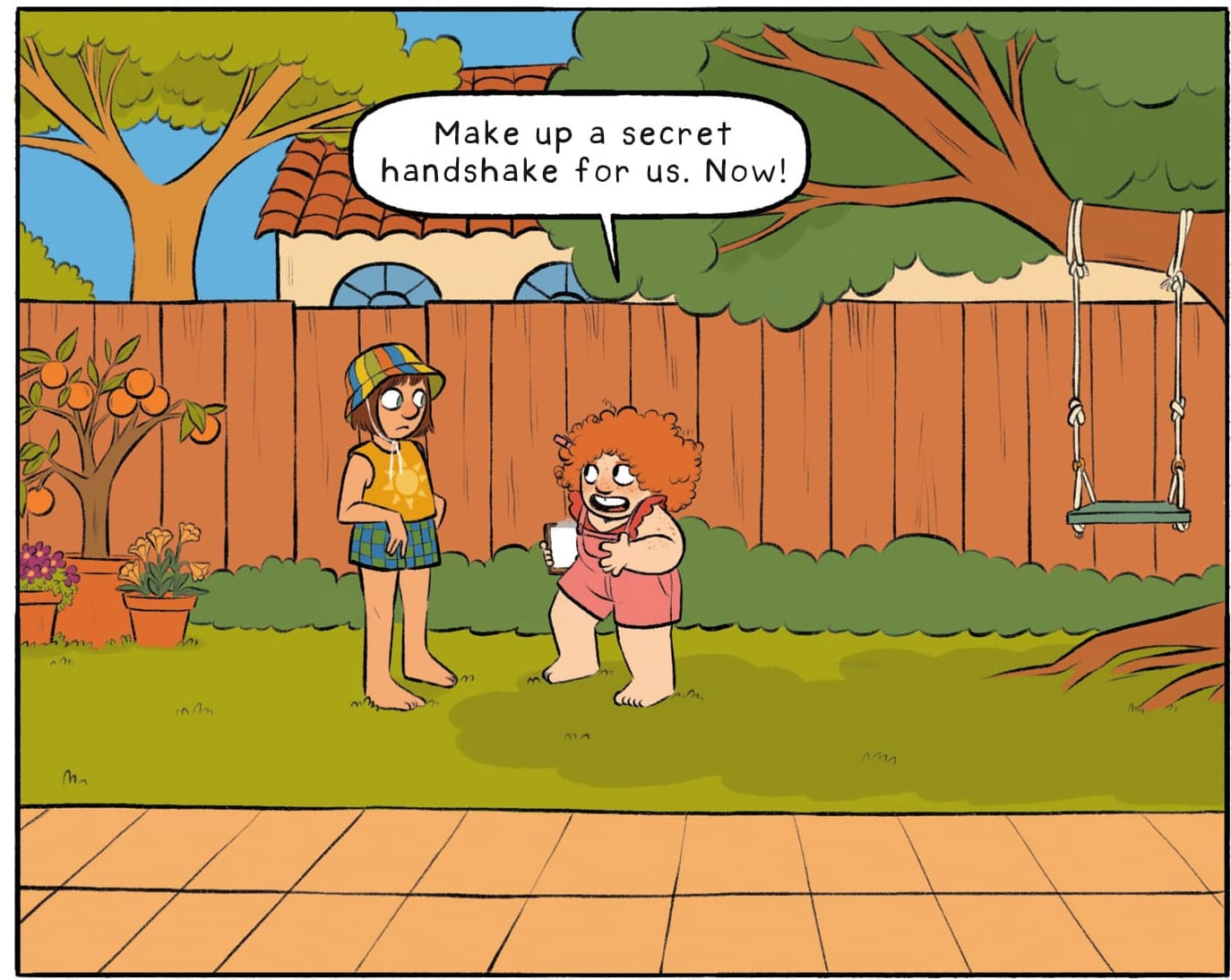
What font do you use for your lettering?
ES: I made a font! I think I called it Lucky. Not sure why.
I have other fonts of my handwriting, one that I used for the “Nell of Gumbling” series. This one - and I’m no font expert, so these are probably egregiously untechnical terms - I made a little rounder, a little friendlier, I guess. Sometimes I’ll look at it and go “does my handwriting look like Comic Sans?”
Well, Comic Sans is based on a handwriting so…
ES: And I like Comic Sans. I’m not a hater when it comes to Comic Sans. And that’s on the record!
It’s my handwriting when I’m trying. If you looked in my journal, which don’t. It’s private. But that’s much more chicken-scratchy. When I was this age, I was really into my own handwriting, as many eight graders are. Just making it so perfect. I’d got my little gel pens and everything.
Did you make it for this book?
ES: Yeah, I did make this one for “Last Day Pool Party.”
It is very nice. It’s got that bounce to it.
ES: Thank you!
Is this pen that you use to make the borders on the balloons also the same as the panels?
ES: Yes, they’re the same. That’s sort-of an inkier pen. I used that one for the linework in “The Okay Witch.” The characters here are drawn with a more pencily brush that I’ve gotten more comfortable with over time. I think these are all modifications that I’ve done on Kyle Webster brushes. It’s been a long time so I’m not sure.
I’ve been working with the same exact tool set for a very long time so I don’t always remember the exact origin. But I licensed it!
Do you think you’re getting the itch to try something new or are you like…nah. No way.
ES: Well see. I always want to try and learn a new art software or try new things. The truth is, more often than not, I’m on schedule for another book and sticking to my routine is the most efficient way to go. I end up doing more exploration in the actual world of pen and paper.
I love trying out new pens, like poscas or the watercolor ones. Ohuhu, I think they’re called? Those are great. I would like to do more experimenting, but I don’t.
Sadly, time is often a luxury, especially when you’re on book deadlines.
ES: I feel like the area I try the most new things, because I didn’t do this much in my other books, is in the depiction of water. I ended up troubleshooting a lot of different techniques for drawing splashes or drawing reflections in the water, because I love looking at water but I’m not a terribly realistic renderer as an artist. I knew it wasn’t going to look realistic but I thought there’s gotta be a way so it’s still evocative, still feel like you’re looking at people jumping into a pool or people waiting around. It’s definitely impressionistic and streamlined and cartoony.
Eventually I found something where I went “I think that looks right.” It looks evocative of how water works and matches the style of the rest of the book. It looks like these kids’ water.
When I was growing up, a lot of the animation I watched was adjusting to incorporating CG elements. It was always jarring when it was a traditionally, hand-drawn animated movie and then all of a sudden you’re at a big action set-piece and there’s a huge monster or obstacle that’s obviously rendered in pretty proto-CG. It’s not seamless.
I always remember being taken out of the story when that happened. I like for all the elements of my world to match. They don’t all have to look fantastic or as good as they can be, that’s not what’s interesting to me, but I do want them all to look like part of the same story.
You want them all to mesh together.
ES: Yeah. Exactly.
While you were talking about the pool, I got to thinking about the role of adults in the comic. What was your thought process of incorporating them without having them…they’re background characters. They’re there but not part of the focus. Did you have to resist an urge to make them a more important part?
ES: When you’re a kid, adults are part of your world. They drive you places, they’re chaperones. Sometimes you even love them [laughs.]
Adults are a part of a kid’s world and I didn’t want to pretend that wasn’t the fact. That requires a lot of suspension of disbelief because sometimes they get involved in your social decisions. Sometimes for good, sometimes for ill. Oftentimes adults are speaking to themselves as children, going “well, here’s what I would have done or what I wish I had done.”
In the case of Rose, she’s got a mom who is like “you gotta go for it. Make sure they know who you are.” She’s responsible for Rose going out of her comfort zone, which is initially pretty unsuccessful then ultimately pays off when she’s able to make a connection with another kid.
Or in the case of Paul, his parents are going to his brother’s baseball game. He can join or not. I remember as a kid, sometimes you had to make a decision of, where are you going to be stuck? Are you going to be stuck at your older sibling’s thing or are you gonna be stuck at this thing your cousin is going to?
In a lot of cases, the adults are creating the impetus for the kids being at the party or what they’re doing at the party. Once the party gets going, they really take a backseat. I think Dustin’s dad is at the grill for one panel. I hope this isn’t going to sound incredibly pretentious but in a Shakespeare comedy, when characters enter the forest, the rules of the real world no longer apply. That is where incredibly whimsical, ridiculous things can happen because now you are in the forest and it’s the forest’s rules.
That’s how I feel about the pool party. There have been very realistic limitations that have gotten the kids to this party: they need a ride somewhere; one of their caretakers needs to be with them so this is where they’ve got to go; they had a parent who was willing to push them out of their comfort zone and send them, in Rose’s case, to make an impression. In Maia’s case, she’s being forced to go there to make an apology, to make amends with a kid whose feelings she hurt.
The parent’s logic is what got them to this place but then once they’re at the party, that is where the adults fade into the background and it's the world of kids. Kids interacting with each other, messing up with each other, trying to make themselves seen.
Are there any Shakespeare plays that really connected with you or was this one of those, as a theater person, you hated them?
ES: I like Shakespeare. I’ve had plays where I had fun. Mostly reading! I’ve only ever been in “Midsummer Night’s Dream.” I was a made-up - we had too many people so…there are the named fairies from the original: Mustard Seed, Peaseblossom. I was Dewdrop, a made-up fairy. I believe I wrote an entire background story for this fairy.
I feel like, kids this age, if they’ve been in a Shakespeare play or read it, it’s “Midsummer Night’s Dream.” It’s fun. It’s got so many…you know what? I’m just going to say. “Last Day Pool Party” is very “Midsummer Night’s Dream”-core because in “Midsummer” you’ve got all these factions.
You’ve got the mechanicals putting on that play; you’ve got the fairies and their whole power play between the Fairy Queen and the Fairy King; you’ve got the love quadrangle between the young people who have entered the forest and had their world turn upside down: Lysander and Hermia and Helena and Demetrius.
I want you to know this wasn’t conscious as I was making “Last Day Pool Party” but now that I’m thinking about it, that totally makes sense. Really, most of what I was inspired by - and these are not particularly things I would recommend my audience to view - is the whole subgenre of movies about the last day of high school.
Dazed and Confused. American Graffiti. Can’t Hardly Wait. They go to some rude and raunchy places so I’m not going to recommend them to my audience but it’s a legacy I paid attention to and have gone, Oh. It’d be fun if there was one of those for littler kids. Because I remember how loaded a single day felt when I was that age.
But! Those do feel in the tradition of “Midsummer” where you have all these characters with their own things going on, crossing over in one place, and everything going haywire. And I’m going to claim my membership to that club.
I mean, you do have the butterflies.
ES: I do have the butterflies! That’s fairy-like.
That was real. This was in elementary school and we had milkweed plants in the schoolyard so there would be butterfly chrysalises we would, every recess, track the development as they hatched into butterflies. We formed a little bit of a society around it? Like a pretend play. “This is the butterfly time.”
It would not raise your social status to do this butterfly town but I had a lot of fun. So this was a little nod to my hobby at that time.
As for other Shakespeare plays, I enjoy them and I enjoy noting what is part of different legacies. Where certain tropes we still use in storytelling can loop back to. I always think that’s incredibly interesting. I’m trying to think if I have a favorite? I like “Much Ado About Nothing.” It’s pretty good and I loved the movie with Emma Thompson and Kenneth Branagh.
And that’s a movie. They got the summer tone right. It makes it feel like summer when you watch that movie.
Does that mean everyone is just sweaty the whole time?
ES: [Laughs] Glistening! They’re glowing.
There we go! That’s the Shakespearean way.
ES: It’s like a Tuscan villa. Very sun-soaked. That kind of thing.
Are there any other plays that are your go-tos? Like from your theater background that have stuck around in your head?
ES: Yeah. I’ve been in a lot of plays. I’ve done a four girl production of “The Music Man.” I was Professor Harold Hill. I still do some improv. I really enjoy it.
I was thinking that the characters are very theatrical in “Last Day Pool Party.” Reading Dustin, I’m like, I remember Dustin. I hung out with a lot of the theater kids at school as well (and the bakers.)
I went to a magnet school so we were divided up into our little areas.
ES: Your specialties?
Yeah. I was in the science academy but I hung out with a whole bunch of different groups. And I can see the crossover and the feel in these groups as well.
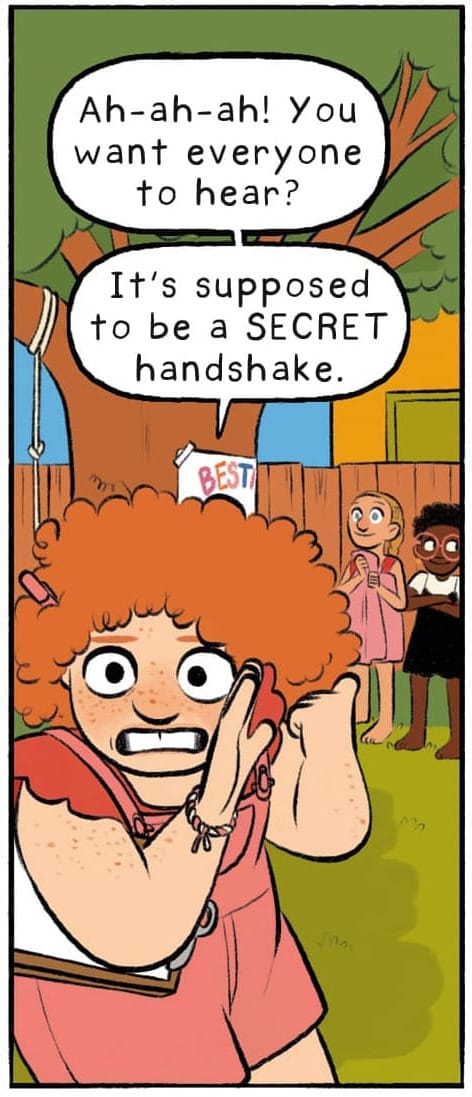
ES: They are theatrical. There is drama. I mean, she holds best friend auditions. I didn’t have to call them auditions. But I have my roots in theater. They’re auditions.
All of my characters, and this is true of my other series, everyone gestures and expresses themselves very…I do get a bit of a reputation for having very, very theatrical gesturing and facial expressions in my illustrations.
It makes it a lot of fun.
ES: This is a video interview. You can tell that’s how I behave. [Editor’s note: it’s true.]
I’m often modeling for myself. My fiance will often walk in and be like, “what’s wrong?” because I’m drawing a character who’s despairing and I’m taking that on in my face and my body. I feel along with these characters.
Do you do reference photos or are you feeling it and noting how it feels?
ES: Kind of both. The latter, that’s unconscious. When he comes in and I’m frowning because the character is frowning, I’m not modeling for anyone. I’m just thinking “frown frown frown” and that’s what’s happening. I’ve definitely modeled for poses that are a little tricky to imagine in my head. I’ve had friends model for me.
It’s very helpful because I’m not an expert in human skeletal structure. I’ve tried to notice a lot as an illustrator but I don’t have it all stored up here. So it can be very helpful to have someone act that out.
What scene or piece of a scene did you find the most challenging to draw and then find yourself the most excited to draw?
ES: I think I was pretty excited to do when Rose is trying to check off all of her action items, like the goals I want to accomplish before the end of Junior High, and then trying to accomplish them all at once at this pool party. I enjoyed doing that because it was, like, one goal per page.
I do much longer graphic novels but I love three panel, Sunday funnies, where a whole story can be told in, like, one two three. Or, if not a story, a little bit. A little joke. I enjoyed the challenge of, per page, doing one joke.
I’m trying to think what was the most challenging? The truth is, a lot of the challenge stems from having the whole pool party on some pages. Like getting all of those kids there. If you were filming a movie of this, that’s so many extras! And when you’re an illustrator…you’re drawing all of them. Especially when it’s multiple panels and I have to remember where each kid is. That can be a little bit of a pain but it’s also pretty rewarding because I can go back and say “I did that! I actually pulled it off.”
I’m sure there are places where you look from one panel to the next and you’re like…how’d that kid get there?!
They ran.
ES: Exactly.
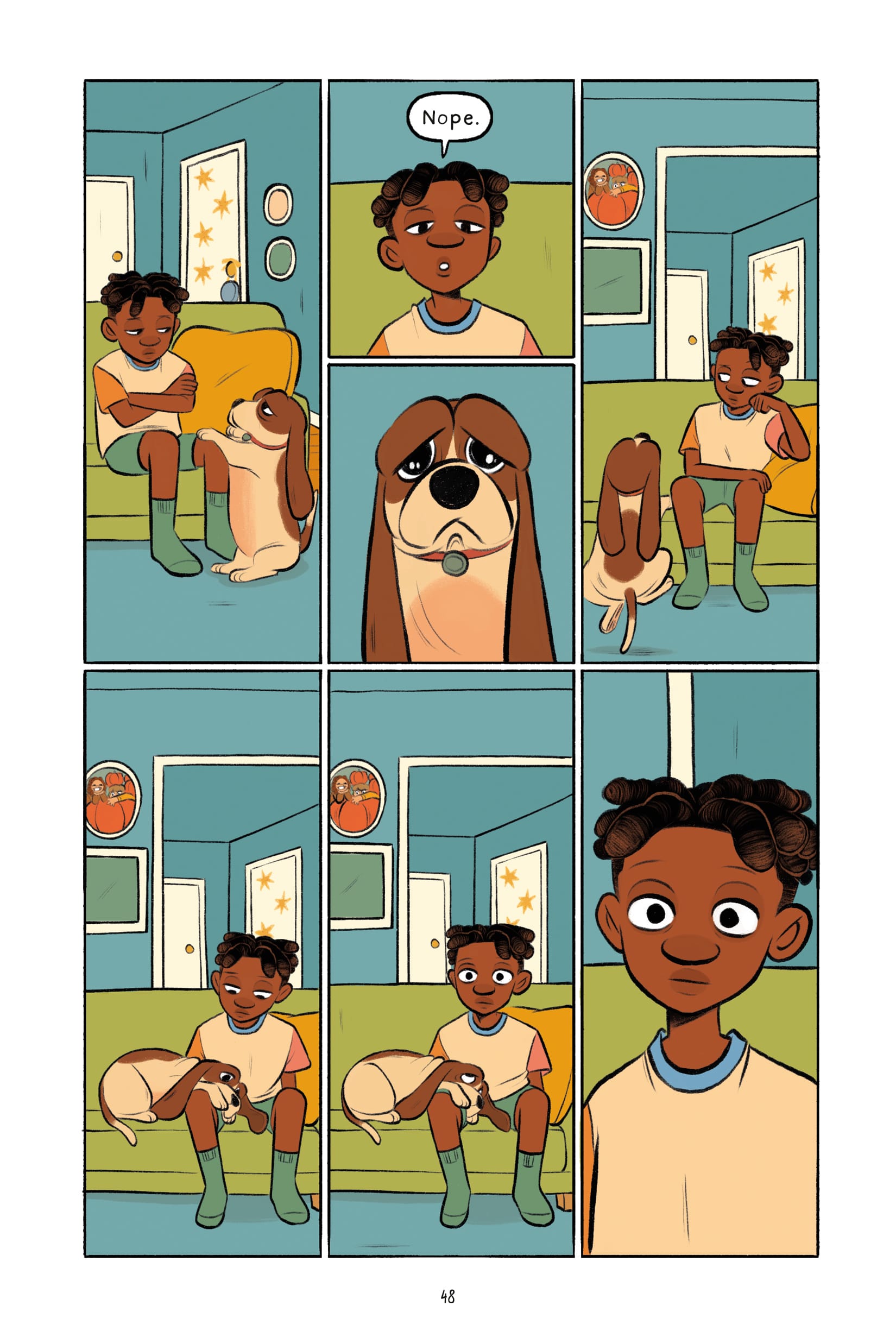
While you were looking for scenes, I found the scene of Dustin messing with his hair. I love Flopper [the dog]. Flopper’s so good.
ES: Did that ever happen to you?
No. But we’ve also only ever had cats. No dogs to be like “this is my hair now.”
ES: I’ve never had a dog lick my hair but I have had the minute before people arrive be like, “Wait. That’s what my hair looks like?!” And you try to fix it and you make it worse.
Brutal.
You gave Dustin some of the more brutal moments.
ES: It’s tough. When you’re already in a hold, it’s harder to get out. He’s already so close to the bottom of the food chain. It takes a lot of work to drag yourself out of that. Yeah, poor Dustin. I love that guy.
I really did love all six of them. Being able to see their interactions, even if Liv [best friend audition holder] maybe got me the most. I was like [sigh] oh nooooo. Don’t just completely blow it up. I was reading through my hands at that point.
ES: I myself am uncomfortable with cringe in real life but I did want to turn it up a little bit in this story. I do want you to feel that. I’m sorry but it worked.
One unrelated question before the end: do you have that bucket hat?
ES: I…don’t have that bucket hat. I think I had one…oh boy I’ve had some hats. I did, at my eight grade graduation, wear a - because I was super into vintage clothes and vintage shops and thrifting at the time. I felt like I had just invented it. I was like “oh my gosh I can’t believe no one at my school has even thought to do this!” And I’m not picking out cute things necessarily.
So at my eight grade graduation, we didn’t wear robes and caps. We could wear, you know, we were supposed to wear just a nice thing and I wore a red hat with a little blushing veil. Like a 1940s style hat. It was kind-of a look. I did probably eat a little bit. I would need to see a photo because I’m looking back and going “what was I doing?”
I know I had a bucket hat that was pink and blue houndstooth.
Interesting.
ES: It was something that would have looked great on Hillary Duff in a movie but when I wear it, it ends up looking a little dorky. A lot of us are going through a bit of a hat era in this time in life. You just gotta make it through.
I’m looking now at Paul playing video games.
ES: I’m not much of a gamer myself but I like ot watch other people play video games..
It’s an underrated pastime.
ES: It’s nice!
Especially when you get to bug them with questions?
ES: Oh yeah. I’m a little sister so that’s my bread and butter going up and saying “what are you doing who’s that?” And my brother’s going “It’s Mario. You kidding me?”
Are you excited for “Last Day Pool Party” to get out in the world?
ES: I am. I love reading middle grade graphic novels that are very very true to life adolescent comedies that put you back in that place. Or in the case of the majority of the readers, that makes you feel seen, I guess, in your own awkward little life which everyone has. No one has it figured out. I love reading books like that and I’m really excited to have been able to make one.
I’m excited for it to come out. I’m excited for kids to read it.
Think you’re gonna do more in this vein? Or will you travel to somewhere new?
ES: I would be very open to it. I really really enjoyed doing that. So we’ll see.
 Elias Rosner
 Elias Rosner
Comments ()