Book Review: "Kiki's Delivery Service" & "Kiki & the New Magic"
Which witch is which? Why, this witch is which!
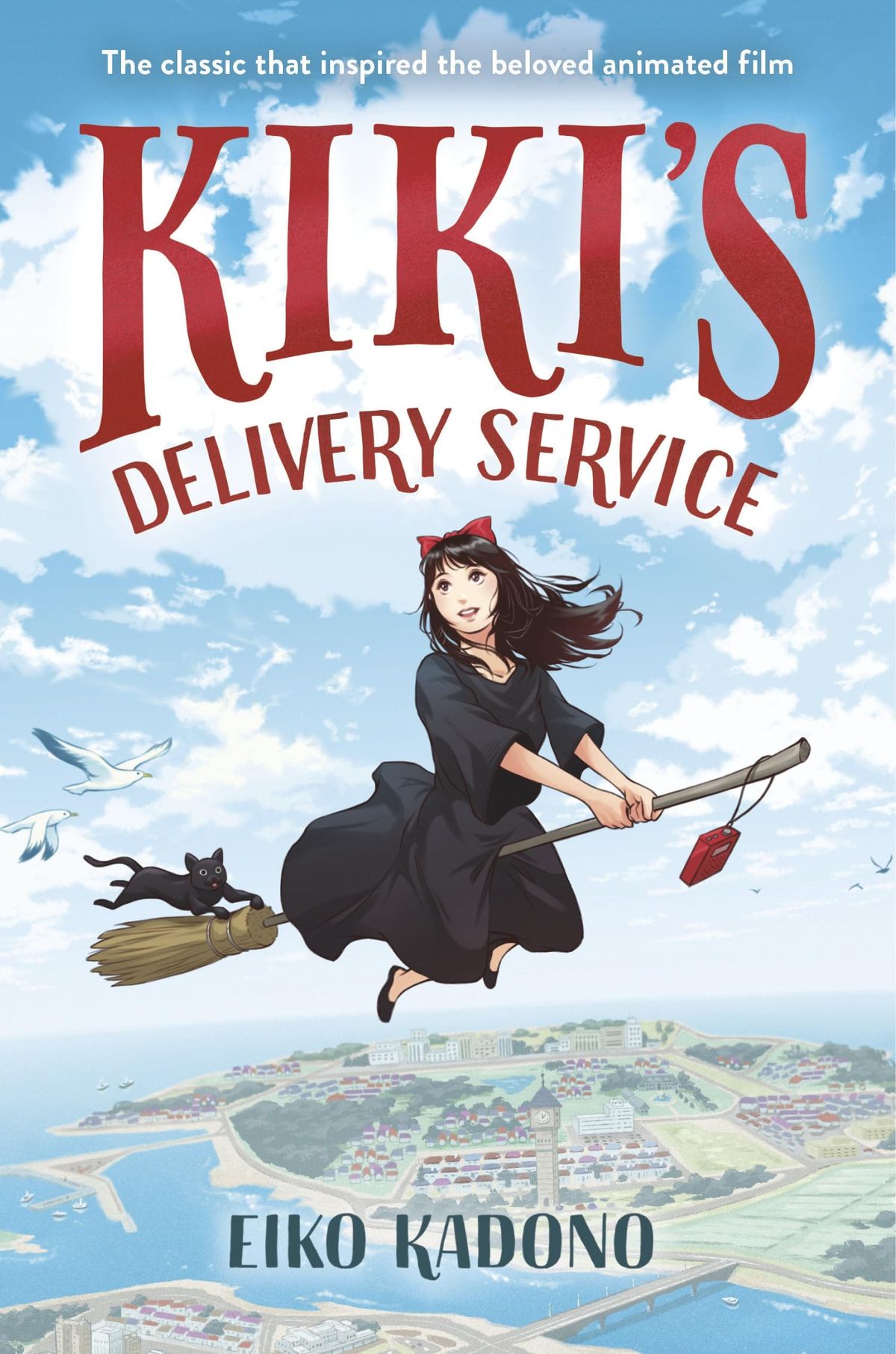
It’s been a long time since I’ve read a children’s book. No surprise there. I’m no longer a child. But as one learns as one grows up, just because something is for children doesn’t mean it isn’t worth reading as an adult. In fact, the very best children’s novels are multi-generational, full of lessons or adventures for all. “The Phantom Tollbooth,” “The Hobbit,” “Frindle,” the “Magic Treehouse” series are just a few examples of these, each sitting at a different point along the “children’s book” spectrum, from adult books for kids to what we now call middle grade fiction to classic chapter books.
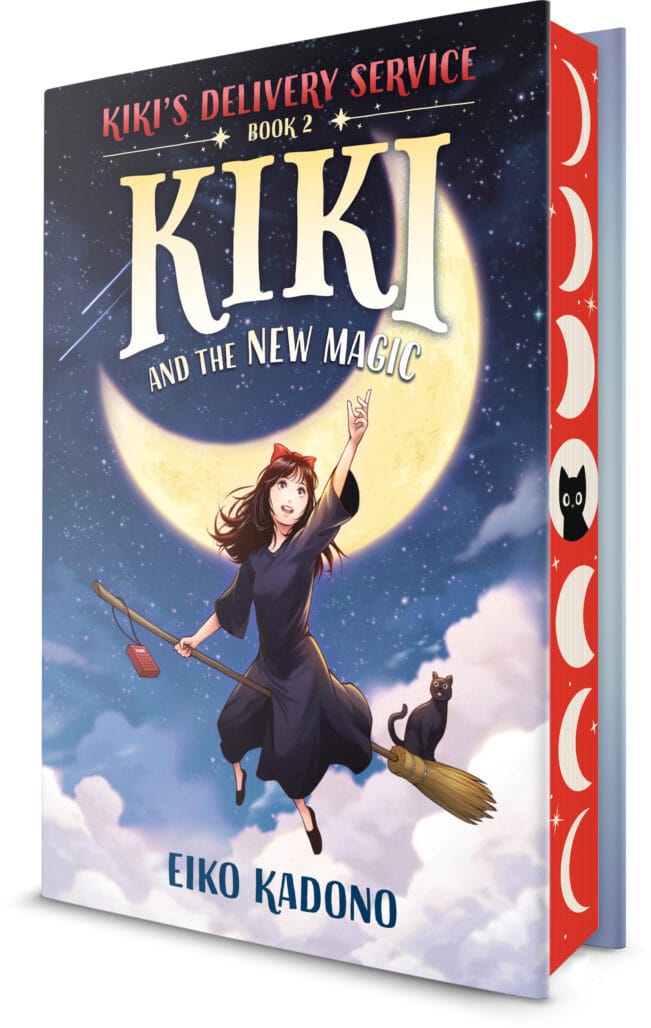
Eiko Kadono’s “Kiki’s Delivery Service,” (originally 魔女の宅急便, Majo no Takkyūbin) and its sequel “Kiki and the New Magic,” sit in that middle-grade field. I finished the sequel in an afternoon; had I not started the original earlier in the week between bites of lunch, I likely could have finished both in one day.
The first book comes in at around 180 pages while the second is about a hundred pages longer. They’re easy reads, courtesy of a breezy translation by Emily Balistrieri, large text, and the occasional spot illustration by Yuta Onoda to liven up the pages. Delacorte Press did a wonderful job bringing these books back into print and it’s one of those times I find that the foreedge designs enhance the feel of the novel.
Yes, I’ll put it out there. I’m not the biggest fan of the current trend of “deluxe” editions with cluttered, bespoke designs sprayed onto the page edges. Paperbacks really look shoddy with them while only about half the hardcovers benefit. But I digress.
…Ok. One more digression. If the name sounds familiar, yes, this is the novel that the Studio Ghibli film is based on.
Ok. Two more digressions. Want to feel old? That film came out in 1989, with the book having come out just a couple years prior. To be fair to 90s kids, it wasn’t released here in the US until 1997, even though the film actually had an English dub produced in 1989 by Streamline Pictures…but only for Japan Airlines’ international flights. At least according to Wikipedia.
Do you think Kiki would enjoy being on a plane or is flying on her broom more than enough? Hmm? Oh all right. Enough dawdling. Back to the review.
Both books tell a series of lovely tales of a young witch, Kiki, who is learning to live on her own for the first time. Much like a baby bird, when a witch comes of age, she must leave the nest and venture out into the world to find her place. She cannot come home for one year, though she can (and does) write home often.
Over the course of the first novel, she learns how to live independently of her first home, making and finding a new one with her cat Jiji (who talks, of course) while also gaining a new appreciation for her witchiness. During the second, she deepens her relationship to her adoptive town, her friends, possibly a love interest in the ever clueless Tombo, as well as her mother and her heritage. If the first novel is about finding one’s place in the world, the second is about coming to terms with change and deepening one’s understanding of themself.
In both, Kiki is navigating what all kids navigate: the intersection of what one’s parents think they should be like and who they want to be. Kiki loves being a witch, there’s no question there, but she also chafes at it. Kiki is impulsive, modern, so she fusses at all the traditions her mom, Kokiri, insists upon adhering to: wearing all black, for one. The various well-meaning, slightly-overbearing pieces of advice Kokiri gives out certainly does her no favors when talking to Kiki. It puts the two in conflict from the start, though it’s an easy-going conflict as Kadono captures that tension of adolescence and parenting beautifully.
Kiki wants to be independent. Her coming-of-age is fast approaching, she has her familiar (Jiji,) and she’s done everything she has to do. She’s so excited by this prospect, she even makes her own broom and then springs her decision to leave on her parents with only five days' notice. Five days is not a lot of time, her dad remarks, but Kiki feels ready, bursting with energy and joy.
For her mom, Kiki’s coming of age is nerve-wracking. Joyous, yes, but scary too. Her baby’s going off into the big wide world, and on an untested broom of all things! She won’t stand for that. So she tries to impart what she believes and what she has learned onto Kiki: Pick a small town. Be careful and modest. Wear black. Think things through.
Kiki pushes back against her mom’s ideas of the world and of witches. She will forge her own path. “I hate the idea of living my life constantly worrying about what people will say - I’m going to do whatever I want!” she says on page 19. That means making her own broom, picking a large town on the sea, and acting on her impulses. There is no strife or animosity, only the natural push and pull, the give-and-take, of growing up and letting go.
Of course, her mom gets her way with the broom, Kiki gets her way with the town, and they’re both right about Kiki’s impulses: they get her into trouble just as often as they get her out of it. Kiki’s semi-sheltered nature makes for some comedies of errors for the first few chapters of “Kiki’s Delivery Service” but she also gives as much as she gets.
Yet the books aren’t really a “modernity vs tradition” narrative. One is not better than the other. Often to preserve tradition, one must integrate the modern. Kiki loves her heritage, even if she chafes against wanting to make the sneezing medicine that’s her mom’s Witch Skill, while also believing that the world has changed from how her mom sees it.
Speaking of, one of the more powerful sections in the second book is where she finally feels ready to learn her mom’s sneezing medicine recipe. I found the description personally meaningful, especially around this time of year. It’s been two years since my grandmother died. She used to make the gefilte fish for Rosh Hashanah and Passover, as her mom did before her, though she has long since passed the recipe and technique along to my mom.
The last couple years, I’ve been learning it myself alongside my mom. Centering and connective, it’s a special process. She shows me the little modifications we’ve made as tech and access to ingredients has changed. The measurements we had to add when “the cup” my great-grandmother used was no longer around. The funny, somewhat gross processes and the memories shared with my grandmother and her mother before her.
It’s a blessing to carry on a family tradition. It connects us l’dor v’dor, generation to generation. Kiki takes the gift she is given from her mom and cherishes it and prepares to keep it alive. And then Kiki does what she always does and expands it out. Rather than a hidden field, she lines the street with the plants she needs. The process for making the medicine may be particular and personal but that doesn’t mean it needs to be secreted away. It can live in the open, beautifying the world, and inviting others in. To stop, to talk, to ask.
In some ways, Kiki’s is wrong about the world changing. The town greets her with a cold shoulder at first and stereotypes abound, even after she’s known in town, but also wearing black becomes a kind of uniform, a badge of authenticity and is what makes others take her seriously. In other ways though, she’s right. She finds acceptance in a large town and finds that to be a witch in a new time, a new approach is needed.
Kiki is a very unorthodox person. A creative thinker and puzzle solver, for every situation she gets herself into, she will often find a neat way out, even if it does end up with her having to take a few metaphorical (and a couple times literal) lumps, like in “The New Magic” when she wrinkles up the perfectly pressed shirt or loses an apple. It usually works out in her favor, or she learns a lesson.
Anyone familiar with the film adaptation likely knows about the trouble she gets into, or at least the first: Kiki drops a stuffed doll she’s delivering and Jiji has to pretend to be one for a child. I won’t do a beat by beat comparison but I was certainly surprised by how much more childish she comes across as in the books. And by that I mean: her logic is more child-like.
She’s more likely to slack off or let herself loaf around. She’s a little petty and more than once in “The New Magic” almost lets her first impressions of a person override her empathy (not that a few of those customers didn’t deserve a good tongue lashing.) Kadono does an excellent job showing us, well, what a child witch who’s learning to grow up and grow independently would do.
The book is not an adherent to the prosperity gospel, however it may sound. Kiki left home to make it “on her own,” yes, but not all on her own. She still has the support of home via letters and the materials and skills she left with. She has Jiji, her familiar, and throughout the story she relies on the kindness of strangers (who become friends) to survive and thrive. Osono, the baker, takes her in and gives her a place to live, rent free, after she assists in delivering a pacifier to a customer who left it behind.
When Kiki decides her business will be delivering things, Osono makes her a sign and sets her up with a phone. Each person Kiki assists, she asks for a trade in return. Just as she is providing a service she can do that others can’t, so too will they provide one back: tailoring her dress, making a painting, learning how to knit a belly band. Give-and-take. From each according to their ability, to each according to their needs.
It is a good message, and another example of the merging of modernity & tradition that Kadono values. The town expected her to work for money and Kiki could take more from the people she helps than she needs. But she doesn’t because she’s a witch and she says that this is the way they live. She is firm in that and it earns her respect. It seems others match her as well, giving openly and warmly.
I’m getting too serious and I think Kadono would tut-tut me for it. “Kiki’s Delivery Service” and “Kiki and the New Magic” are a pair of joyous and whimsical books full of wonderful and fun writing. I love how silly she can get with the sound effects or things like the New Year’s race or the hippo that needs a fake tail because it has Missing Center Syndrome.
But then again, underneath it all is the seriousness with which she takes her readers. The books are written for a middle grade level but they aren’t afraid to broach heavy topics, particularly in book two. As Kiki is now a year older, she, and presumably her readers, can handle (gently) topics like bullying and, yes, death. I certainly teared up when I realized what Kadono was doing.
Even the silly chapters are full of teaching moments, forwarding Kiki’s character development or her relationships to others. Perhaps, as an adult, it’s all a little trite and certainly not a challenging read. I know. But for a moment, the books remind one what it’s like to be a child in a big world, to dream and learn and laugh and weep and fail and fail and finally succeed. To find one’s place and realize it has been found.
The smell of grass rose from the ground beneath her feet. The moos of cows, both high and low, drifted over the soft breeze. When she lay down and closed her eyes, the light of the sun became green polka dots that moved around under her eyelids as if they were swimming.
How wonderful it is to have a place to return to. (“Kiki’s Delivery Service,” pg. 191-92)
How wonderful it is indeed.
Comments ()